JSC 370: Data Science II

Week 4: More Data Visualization and ML 1

This week

This lecture presents a deeper introduction to plotnine, a Python package that implements the grammar of graphics (similar to R’s ggplot2), providing better graphics options than matplotlib’s default plots.

This week

We will also dig into non-parametric regression with splines and generalized additive models (GAMs).

A generalized additive model (GAM) predicts \(y\) by adding up learned smooth functions of the predictors:

\[ g(\mathbb{E}[Y \mid X])=\beta_0 + s_1(x_1) + s_2(x_2) + \cdots + s_p(x_p) \]

  • Nonlinear: each \(s_j(\cdot)\) is a flexible curve (often a spline)
  • Regularized: we control “wiggliness” with a penalty (bias–variance tradeoff)
  • Fits the ML pattern: choose flexibility by minimizing training loss + complexity penalty
  • Interpretable: you can plot each learned effect \(s_j(x_j)\) (partial effect curves)
  • Generalized: works for continuous, binary, counts via a link \(g(\cdot)\)
  • Mental model: like linear regression, but each coefficient is replaced by a smooth curve.

Background

plotnine is based on the grammar of graphics, the same underlying philosophy as R’s ggplot2. In the Python ecosystem, we use pandas for data manipulation (similar to R’s dplyr), and plotnine for visualization.

The tidyverse philosophy of readable, chainable operations translates well to Python with method chaining in pandas.

Layers, pandas and method chaining

  • We should take a step back and discuss Python’s data manipulation ecosystem.
  • plotnine behaves very similarly to pandas. They share a philosophy of readable, chainable operations.
  • In pandas, operations are typically chained using method calls on DataFrames.
  • Each method takes a DataFrame and returns a new DataFrame.
  • Method chaining in Python uses the . operator (similar to R’s pipe).
  • You can also use parentheses to break long chains across multiple lines.

Flights data

To illustrate many of today’s visualization examples we will look at the flights data from the nycflights13 package. They are all flights that departed from NYC airports (JFK, LGA, EWR) in 2013.

from nycflights13 import flights
print("Columns:", flights.columns.tolist())
print("Shape:", flights.shape)
Columns: ['year', 'month', 'day', 'dep_time', 'sched_dep_time', 'dep_delay', 'arr_time', 'sched_arr_time', 'arr_delay', 'carrier', 'flight', 'tailnum', 'origin', 'dest', 'air_time', 'distance', 'hour', 'minute', 'time_hour']
Shape: (336776, 19)

Method chaining in Python

  • An example using method chaining: subset the flights data to LAX, and take the mean arrival delay times by year, month, day.

  • We need to start with the data, query or boolean indexing to filter to the desired destination (LAX), groupby to prepare the groups that we want to aggregate over, then agg to take the mean.

(flights
 .query('dest == "LAX"')
 .groupby(['year', 'month', 'day'])
 .agg(arr_delay=('arr_delay', lambda x: x.mean(skipna=True)))
 .reset_index())
year month day arr_delay
0 2013 1 1 7.743590
1 2013 1 2 -7.414634
2 2013 1 3 -28.725000
3 2013 1 4 -25.125000
4 2013 1 5 -3.142857
... ... ... ... ...
360 2013 12 27 -29.957447
361 2013 12 28 -15.650000
362 2013 12 29 8.355556
363 2013 12 30 -6.000000
364 2013 12 31 6.230769

365 rows × 4 columns

Alternative syntax with pipe()

Let’s do the same thing using pandas’ pipe() method for a more functional style:

(flights
 .pipe(lambda df: df[df['dest'] == 'LAX'])
 .groupby(['year', 'month', 'day'])
 .agg(arr_delay=('arr_delay', 'mean'))
 .reset_index())
year month day arr_delay
0 2013 1 1 7.743590
1 2013 1 2 -7.414634
2 2013 1 3 -28.725000
3 2013 1 4 -25.125000
4 2013 1 5 -3.142857
... ... ... ... ...
360 2013 12 27 -29.957447
361 2013 12 28 -15.650000
362 2013 12 29 8.355556
363 2013 12 30 -6.000000
364 2013 12 31 6.230769

365 rows × 4 columns

A few coding style tips

  • Variable names should use only lowercase letters, numbers, and _
  • Use _ to separate words within a name (snake_case)
  • Method chains should have each method on its own line, indented
  • Wrap long chains in parentheses for cleaner formatting
  • Each chained method should be indented for readability

Example:

short_flights = (flights
    .query('air_time < 60'))

Flights data in more detail

The nycflights13 package also provides hourly airport weather data for the three NYC airports (the origin). Let’s join the flights data with the weather data so we can look at more interesting relationships in our visualizations.

weather = pd.read_csv('flights_weather.csv')
print("Columns:", weather.columns.tolist())
print("Shape:", weather.shape)
Columns: ['origin', 'year', 'month', 'day', 'hour', 'temp', 'dewp', 'humid', 'wind_dir', 'wind_speed', 'wind_gust', 'precip', 'pressure', 'visib', 'time_hour']
Shape: (26115, 15)

Flights data in more detail

Looks like we can join these datasets on year, month, day, hour and origin (which is the origin airport). We can examine the relationship between flight delays and weather at the origin airports (JFK, LGA, EWR).

A merge with how='left' will keep all of the observations in the left DataFrame (flights) and merge with the observations in the right DataFrame (weather at origin).

flights_weather = pd.merge(
    flights,
    weather,
    how='left',
    on=['year', 'month', 'day', 'hour', 'origin']
)

flights_weather.head()
print("Shape:", flights_weather.shape)
Shape: (336776, 29)

Daily flights data

Let’s make a more manageable sized dataset and summarize the data by month, day, and origin airport by taking the means of the weather variables.

agg_cols = ['dep_delay', 'arr_delay', 'temp', 'dewp', 'humid',
            'wind_dir', 'wind_speed', 'wind_gust', 'precip', 'pressure', 'visib']

flights_weather_day = (flights_weather
    .groupby(['year', 'month', 'day', 'origin'])
    .agg({col: 'mean' for col in agg_cols})
    .reset_index())

flights_weather_day.head()
print("Shape:", flights_weather_day.shape)
Shape: (1095, 15)

Mapping Flight Routes

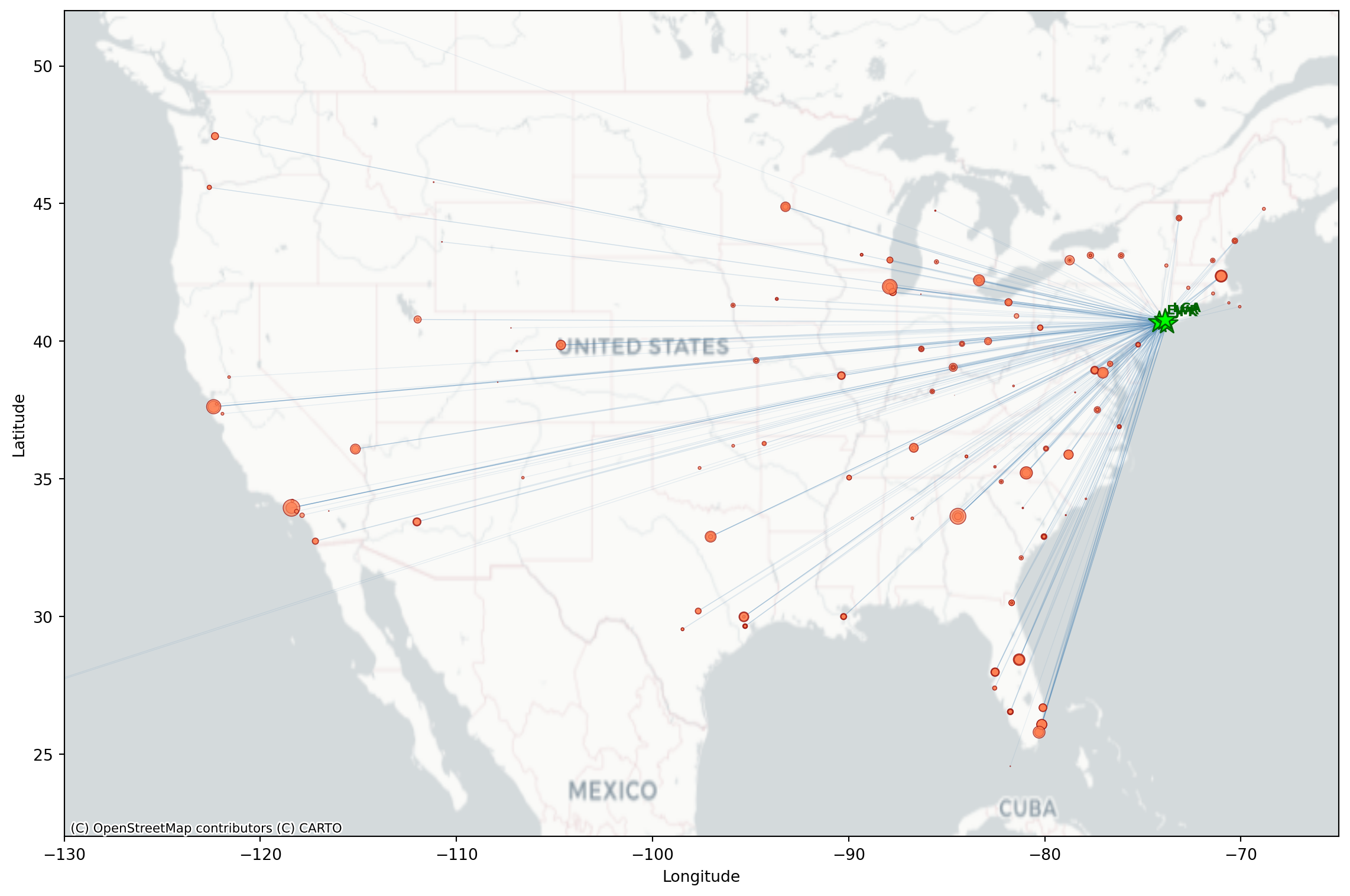
The nycflights13 package also includes airport coordinates. We can merge these in with flights to map where are the popular NYC destinations.

from nycflights13 import airports

# get routes by origin (EWR, JFK, LGA) and destination, count the number of flights per

flight_routes = (flights
    .groupby(['origin', 'dest'])
    .size()
    .reset_index(name='n_flights'))

# extract geospatial and merging info about the airports
airports[['faa', 'name', 'lat', 'lon']].head()
faa name lat lon
0 04G Lansdowne Airport 41.130472 -80.619583
1 06A Moton Field Municipal Airport 32.460572 -85.680028
2 06C Schaumburg Regional 41.989341 -88.101243
3 06N Randall Airport 41.431912 -74.391561
4 09J Jekyll Island Airport 31.074472 -81.427778

Flight Routes Data

Merge flight routes with geospatial information (latitude and longitude) by origin (it is the faa column in airports) and rename to have dest_lat, dest_lon along with origin_lat and origin_lon

flight_routes_geo = (flight_routes
    .merge(airports[['faa', 'lat', 'lon']],
           left_on='dest', right_on='faa', how='inner')
    .rename(columns={'lat': 'dest_lat', 'lon': 'dest_lon'})
    .drop(columns=['faa'])
    .merge(airports[['faa', 'lat', 'lon']],
           left_on='origin', right_on='faa', how='inner')
    .rename(columns={'lat': 'origin_lat', 'lon': 'origin_lon'})
    .drop(columns=['faa']))

print(f"Routes mapped: {len(flight_routes_geo)}")
flight_routes_geo.head()
Routes mapped: 217
origin dest n_flights dest_lat dest_lon origin_lat origin_lon
0 EWR ALB 439 42.748267 -73.801692 40.6925 -74.168667
1 EWR ANC 8 61.174361 -149.996361 40.6925 -74.168667
2 EWR ATL 5022 33.636719 -84.428067 40.6925 -74.168667
3 EWR AUS 968 30.194528 -97.669889 40.6925 -74.168667
4 EWR AVL 265 35.436194 -82.541806 40.6925 -74.168667

Flight Routes Map

Like we saw last week, we can make a basic map we can use matplotlib and contixtily (basemap).

import matplotlib.pyplot as plt
import contextily as ctx

fig, ax = plt.subplots(figsize=(12, 8))

# Set map extent
ax.set_xlim(-130, -65)
ax.set_ylim(22, 52)

# Add basemap 
ctx.add_basemap(ax, crs='EPSG:4326', source=ctx.providers.CartoDB.Positron)

# Plot flight routes as lines (alpha based on number of flights)
max_flights = flight_routes_geo['n_flights'].max()
for _, row in flight_routes_geo.iterrows():
    alpha = min(0.1 + 0.5 * (row['n_flights'] / max_flights), 0.6)
    ax.plot([row['origin_lon'], row['dest_lon']],
            [row['origin_lat'], row['dest_lat']],
            color='steelblue', alpha=alpha, linewidth=0.5)

# Plot destination airports (coords of airport destinations)
ax.scatter(flight_routes_geo['dest_lon'], flight_routes_geo['dest_lat'],
           s=flight_routes_geo['n_flights']/100, c='coral', alpha=0.7,
           edgecolors='darkred', linewidths=0.5, label='Destinations', zorder=4)

# Plot NYC origin airports (use coords of NYC airports origin)
nyc_airports = airports[airports['faa'].isin(['JFK', 'LGA', 'EWR'])]
for _, row in nyc_airports.iterrows():
    ax.scatter(row['lon'], row['lat'], s=200, c='lime', marker='*',
               edgecolors='darkgreen', linewidths=1, zorder=5)
    ax.annotate(row['faa'], (row['lon'], row['lat']), xytext=(5, 5),
                textcoords='offset points', fontsize=8, fontweight='bold', color='darkgreen')

ax.set_xlabel('Longitude')
ax.set_ylabel('Latitude')
plt.tight_layout()
plt.show()

Basemap Options

The contextily library provides several basemap tile providers:

ctx.providers.CartoDB.Positron      # light gray, minimal labels
ctx.providers.CartoDB.PositronNoLabels
ctx.providers.Stamen.TonerLite      # black and white

# Terrain/satellite
ctx.providers.Stamen.Terrain        # terrain with labels
ctx.providers.Esri.WorldImagery     # satellite imagery

# Standard map styles
ctx.providers.OpenStreetMap.Mapnik  # standard OSM
ctx.providers.CartoDB.Voyager       # colorful, detailed

Use crs='EPSG:4326' when your data is in latitude/longitude coordinates.

Visualizations with plotnine

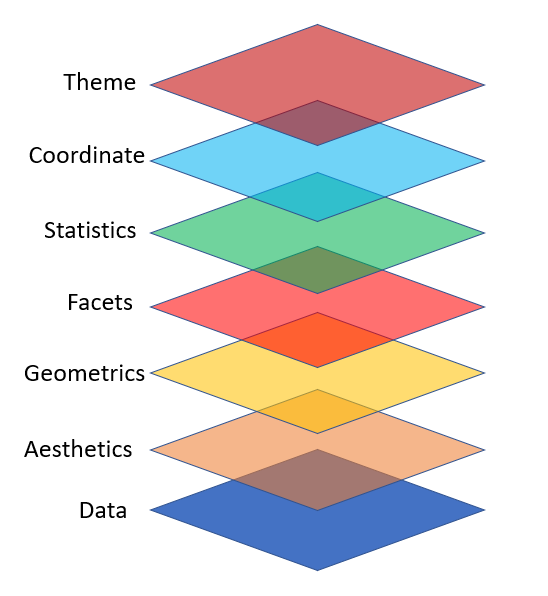
plotnine is designed on the principle of adding layers.

Layers in plotnine

  • With plotnine a plot is initiated with the function ggplot()
  • The first argument of ggplot() is the dataset to use in the graph
  • We add aesthetics using aes()
  • The aes() mapping takes the x and y axes of the plot
  • Layers are added to ggplot() with +
  • Layers include geom_ functions such as point, lines, etc.
(ggplot(data, aes(x='x_var', y='y_var')) +
  geom_point())

Basic scatterplot

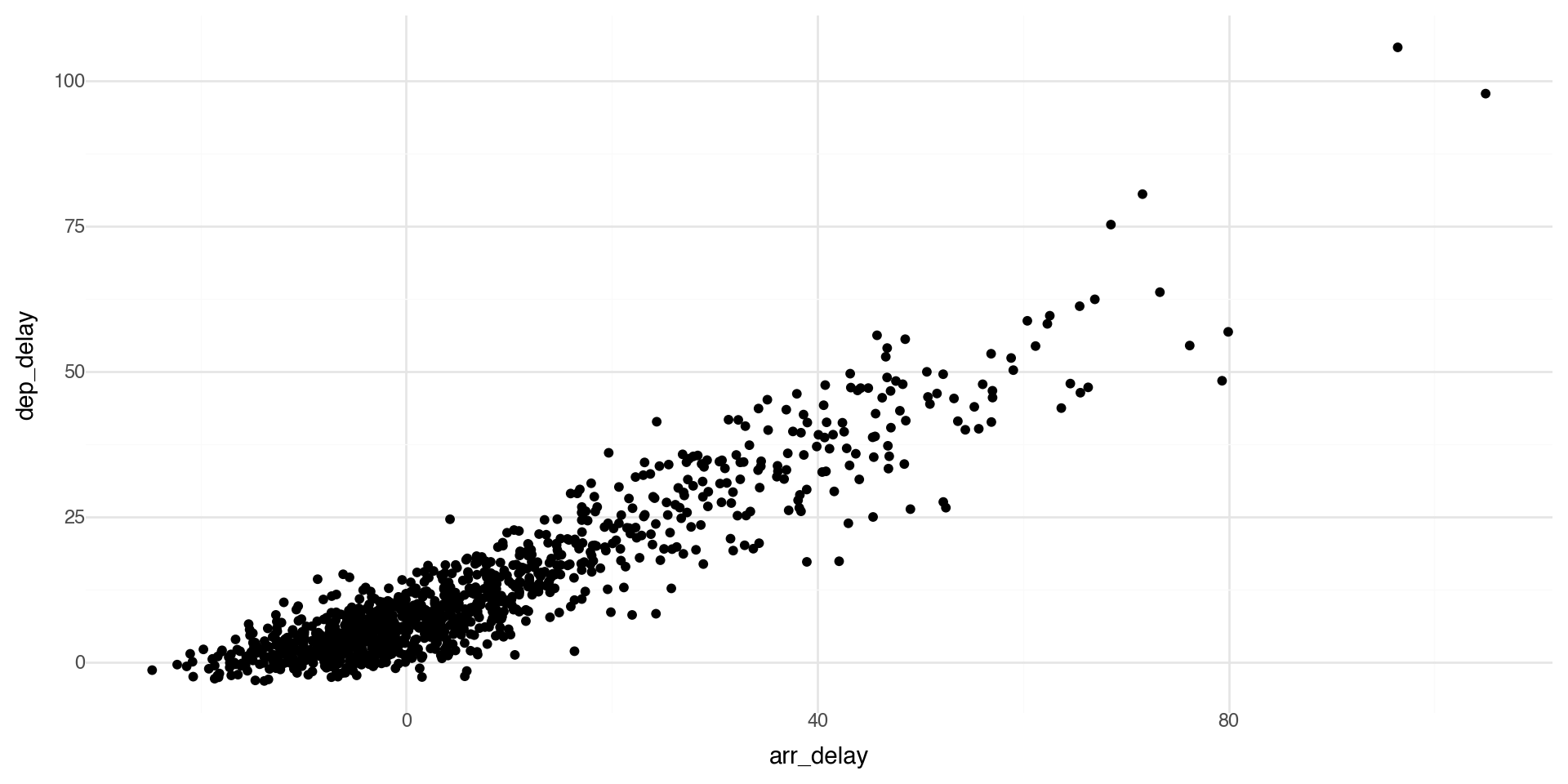
The first argument of ggplot() is the dataset to use, then the aesthetics. With the + you add one or more layers.

(ggplot(flights_weather_day, aes(x='arr_delay', y='dep_delay')) +
  geom_point() +
  theme_minimal())

As expected, we see that if a flight has a late departure, it has a late arrival.

Another basic scatterplot

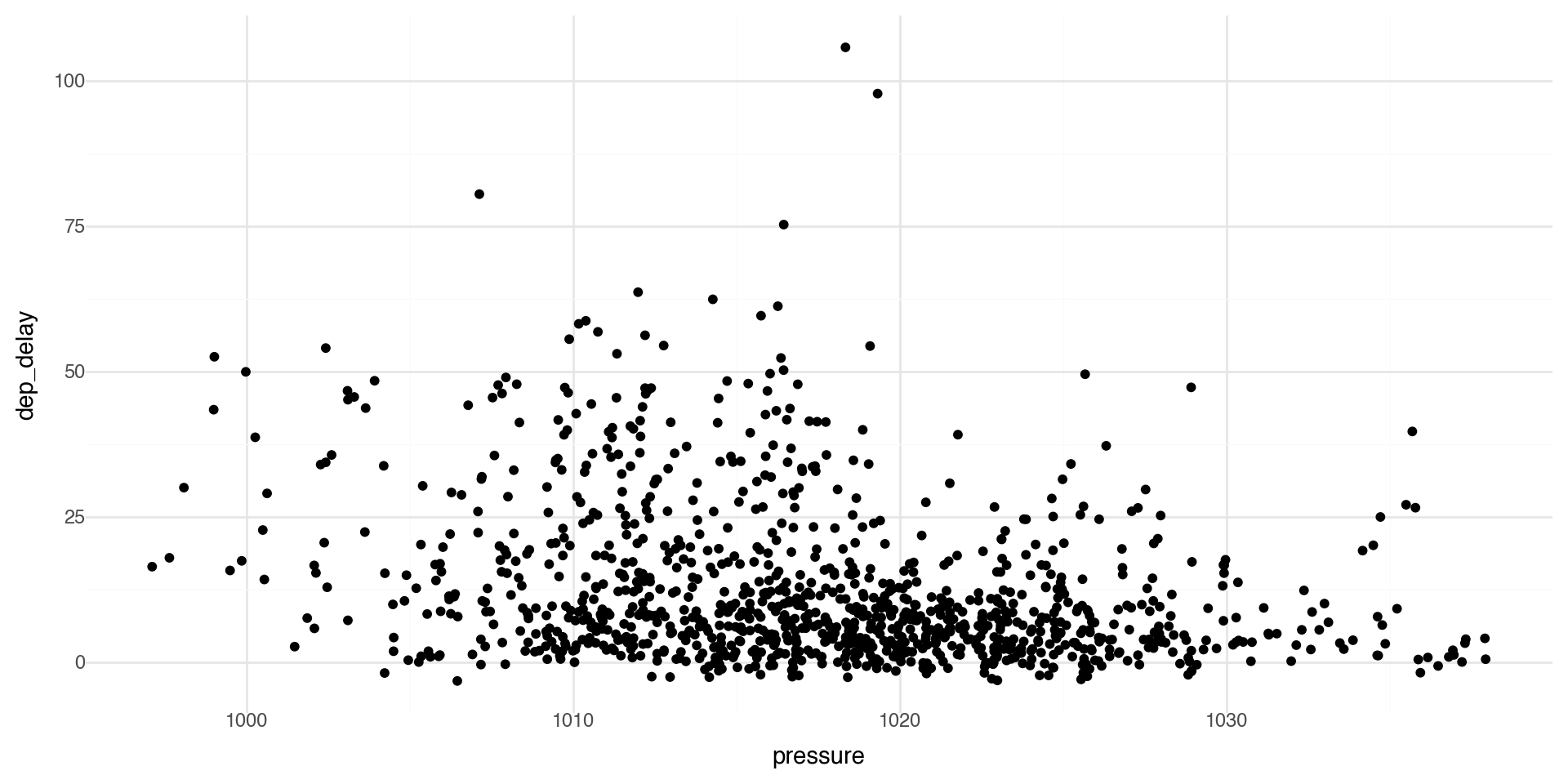
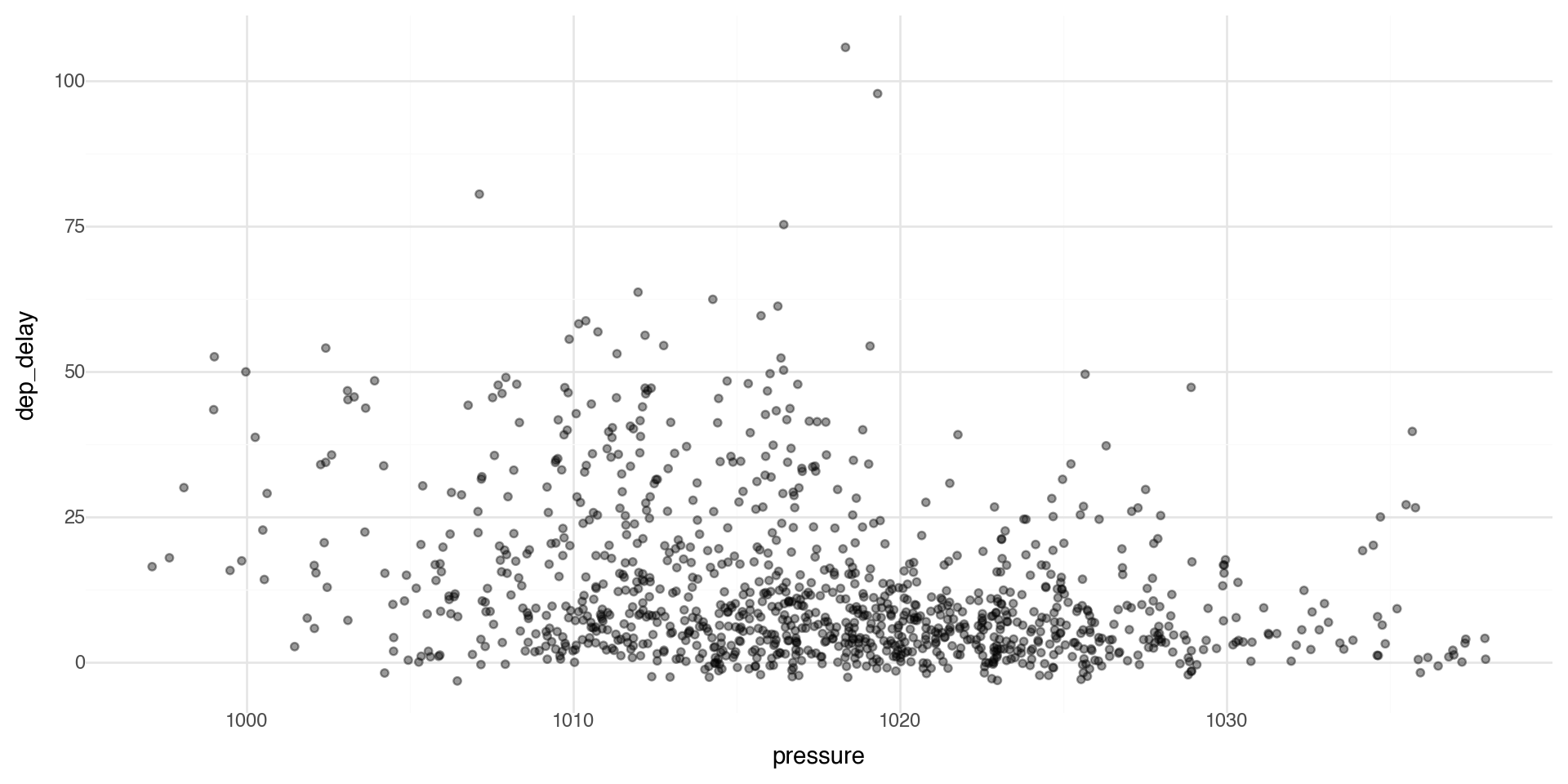
We can see if there is a relationship between departure delays and pressure (low pressure means clouds and precipitation, high pressure means better weather).

(ggplot(flights_weather_day, aes(x='pressure', y='dep_delay')) +
  geom_point() +
  theme_minimal())

Controlling transparency using “alpha”

The alpha control can go in the layer that you are plotting, for example in the geom_point(alpha = ) layer we can directly control the transparency of the points (0 is fully transparent, 1 is fully opaque).

(ggplot(flights_weather_day, aes(x='pressure', y='dep_delay')) +
  geom_point(alpha=0.4) +
  theme_minimal())

Adding labels and themes

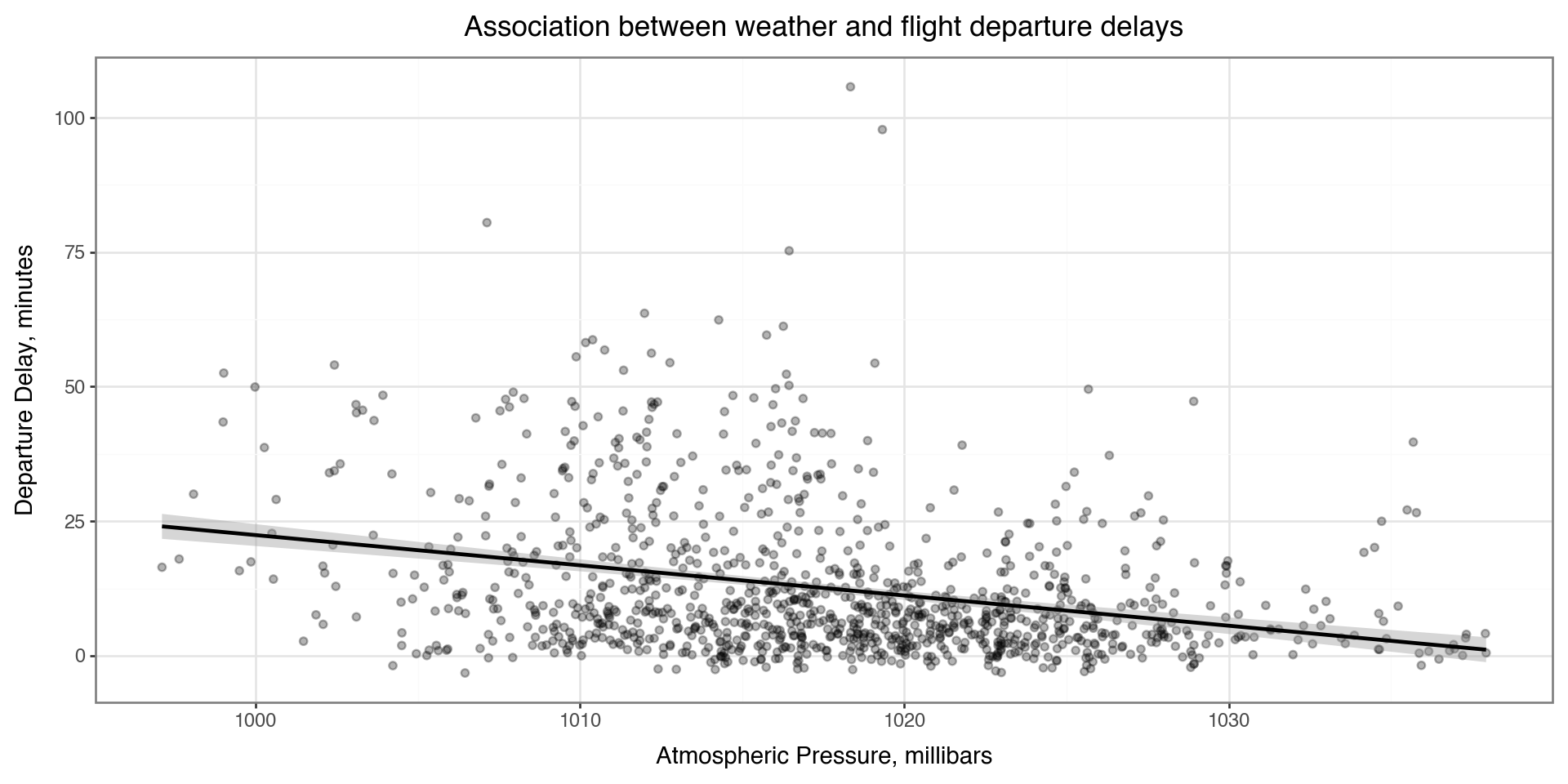
You can make nicer axes and add titles with the labs layer

Also showing a minimal theme that removes the background grey theme_bw() (has a plot border) or theme_minimal() (no plot border, lighter and sparser grid lines)

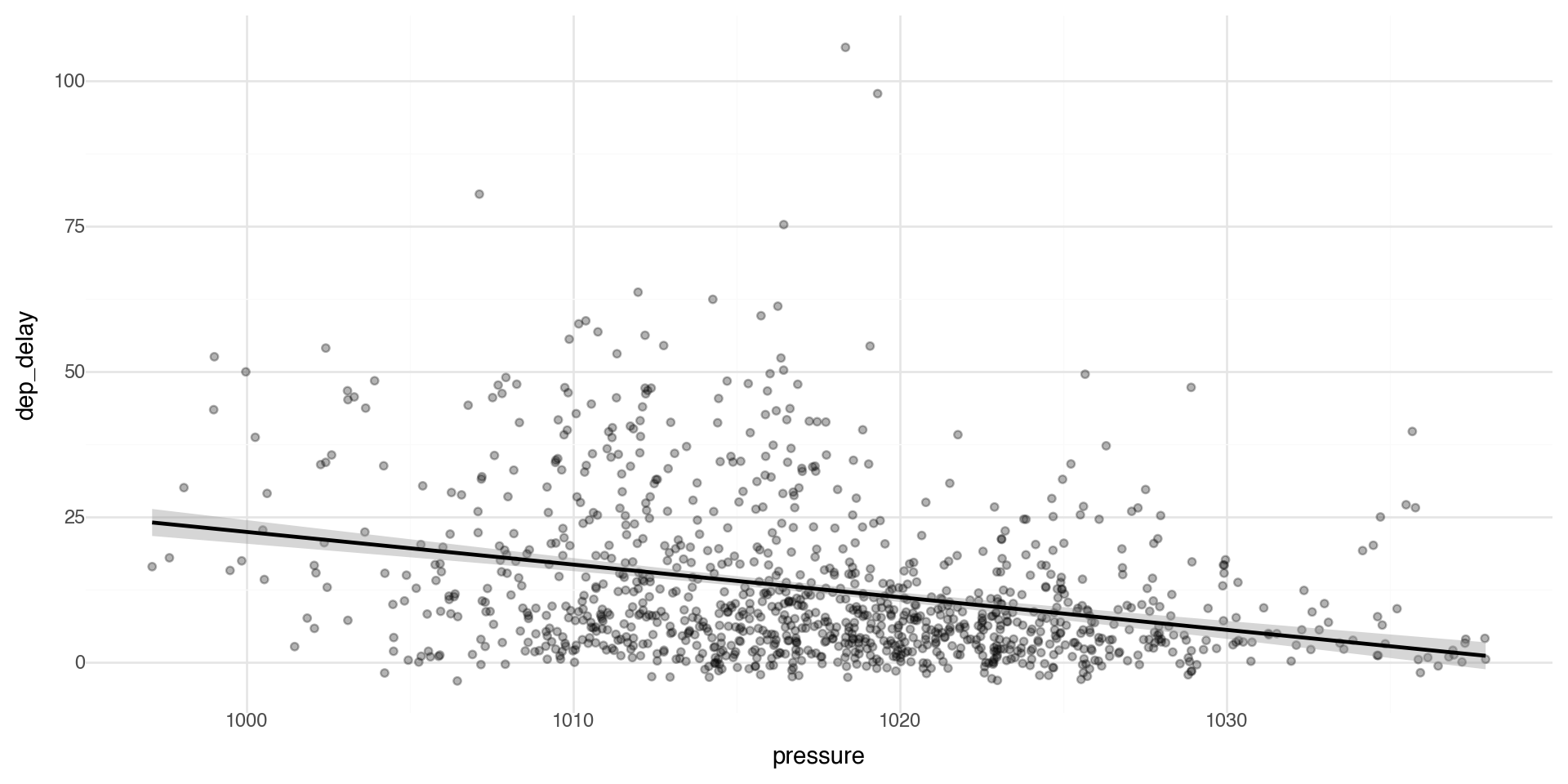
(ggplot(flights_weather_day, aes(x='pressure', y='dep_delay')) +
  geom_point(alpha=0.3) +
  geom_smooth() +
  labs(
    x='Atmospheric Pressure, millibars',
    y='Departure Delay, minutes',
    title='Association between weather and flight departure delays'
  ) +
  theme_bw())

Coloring by a variable - using aesthetics

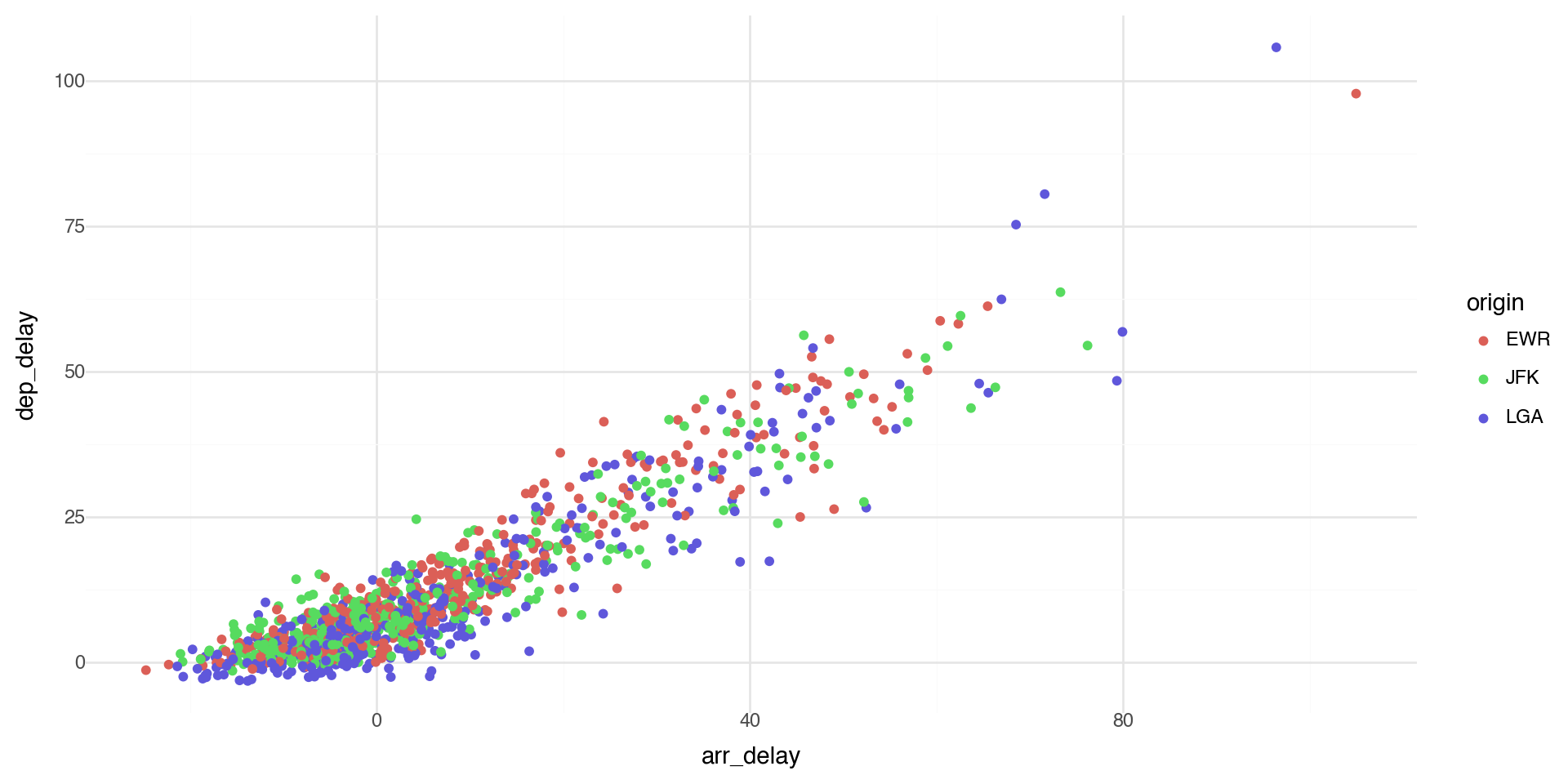
You can convey information about your data by mapping the aesthetics in your plot to the variables in your dataset. For example, you can map the colors of your points to the origin variable to reveal groupings.

plotnine chooses colors, and adds a legend, automatically.

(ggplot(flights_weather_day, aes(x='arr_delay', y='dep_delay', color='origin')) +
  geom_point() +
  theme_minimal())

Coloring by a variable - using aesthetics

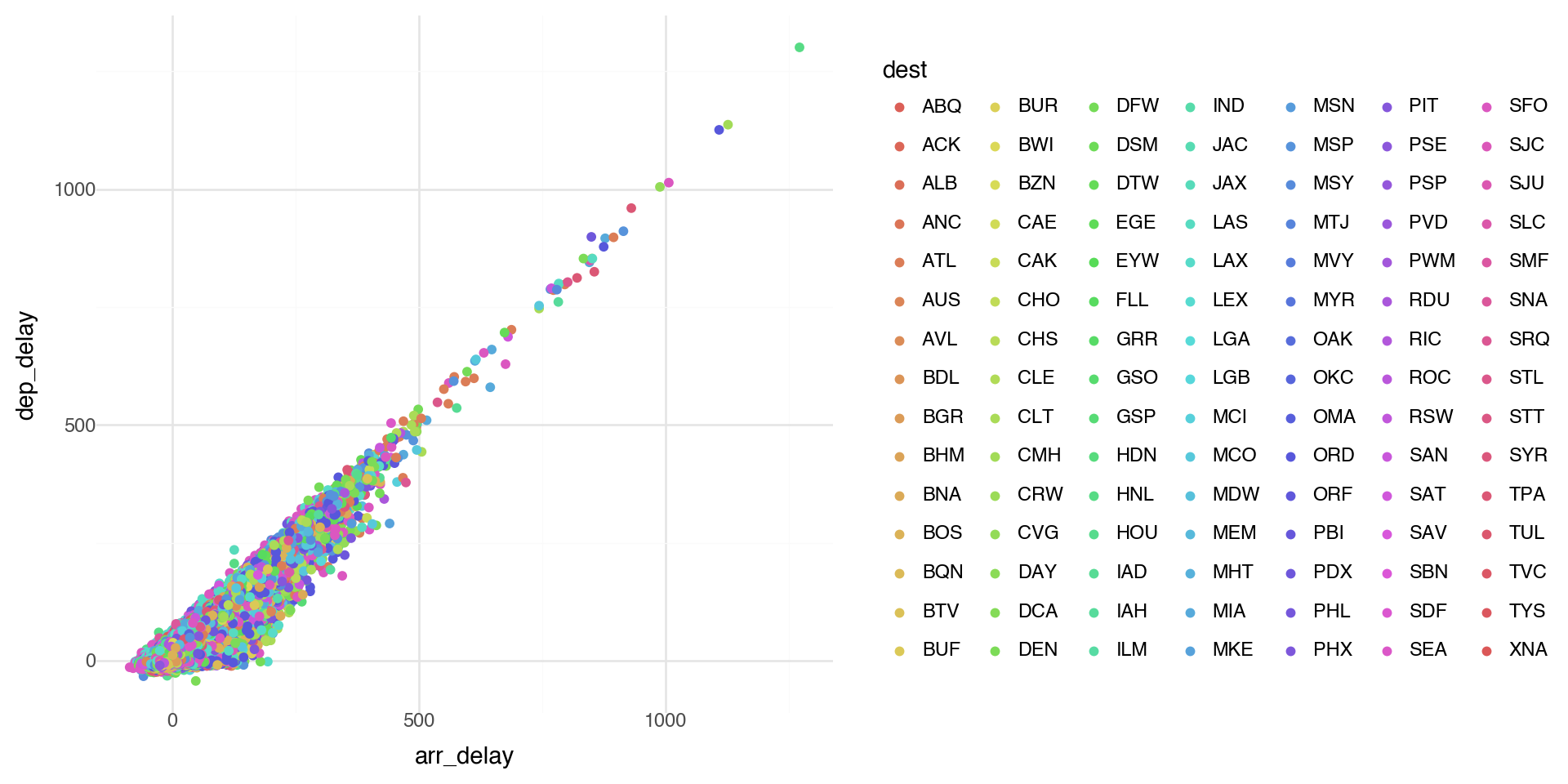
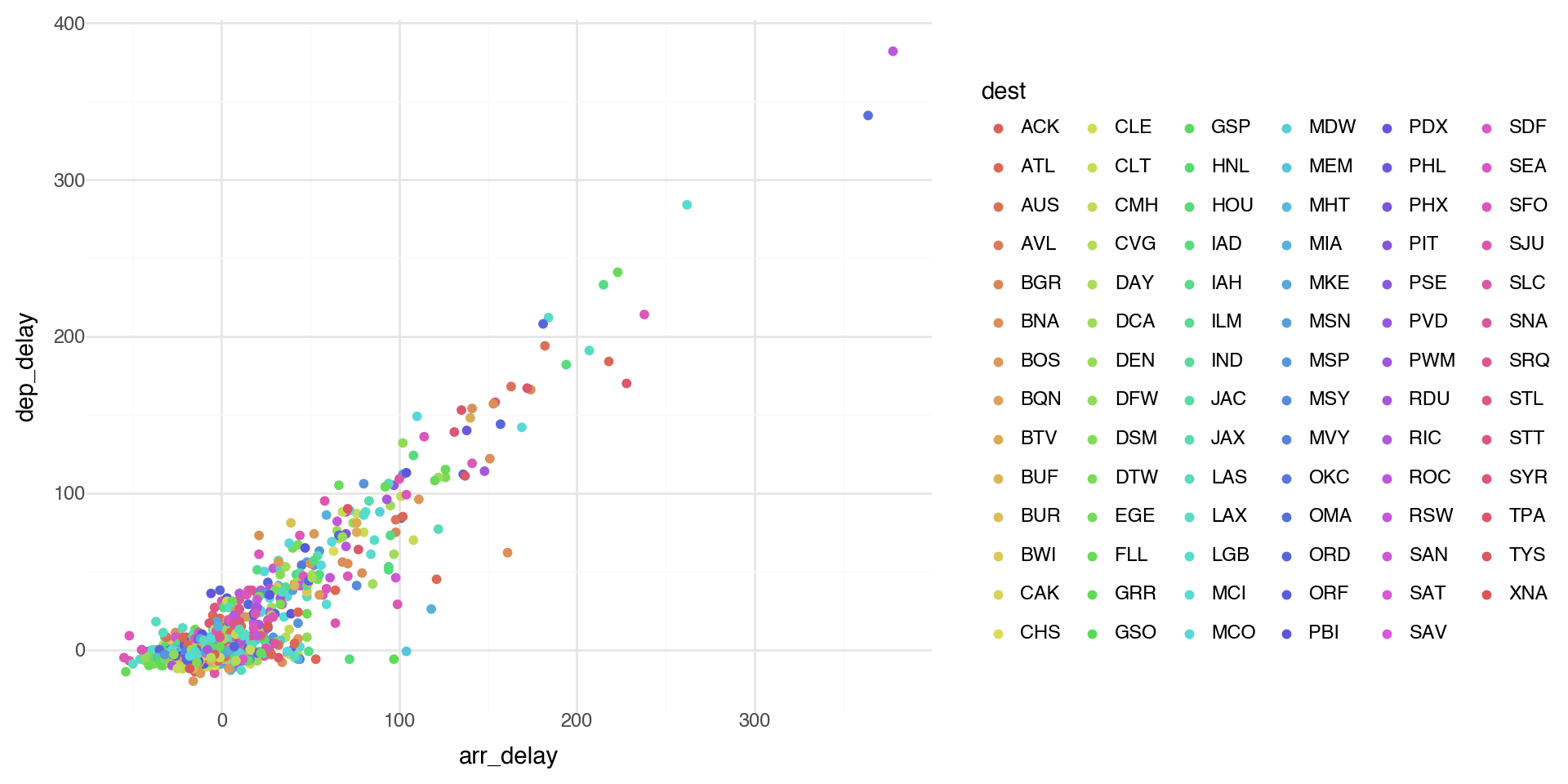
Note when there are a lot of classes or groups, the coloring is not distinguished well.

This is generally bad practice.

(ggplot(flights_weather, aes(x='arr_delay', y='dep_delay', color='dest')) +
  geom_point() +
  theme_minimal())

Coloring by a variable - using aesthetics

Too many points? Take a random sample and plot again.

(ggplot(flights_weather.sample(1000), aes(x='arr_delay', y='dep_delay', color='dest')) +
  geom_point() +
  theme_minimal() +
  theme(legend_position='right'))

Points shape

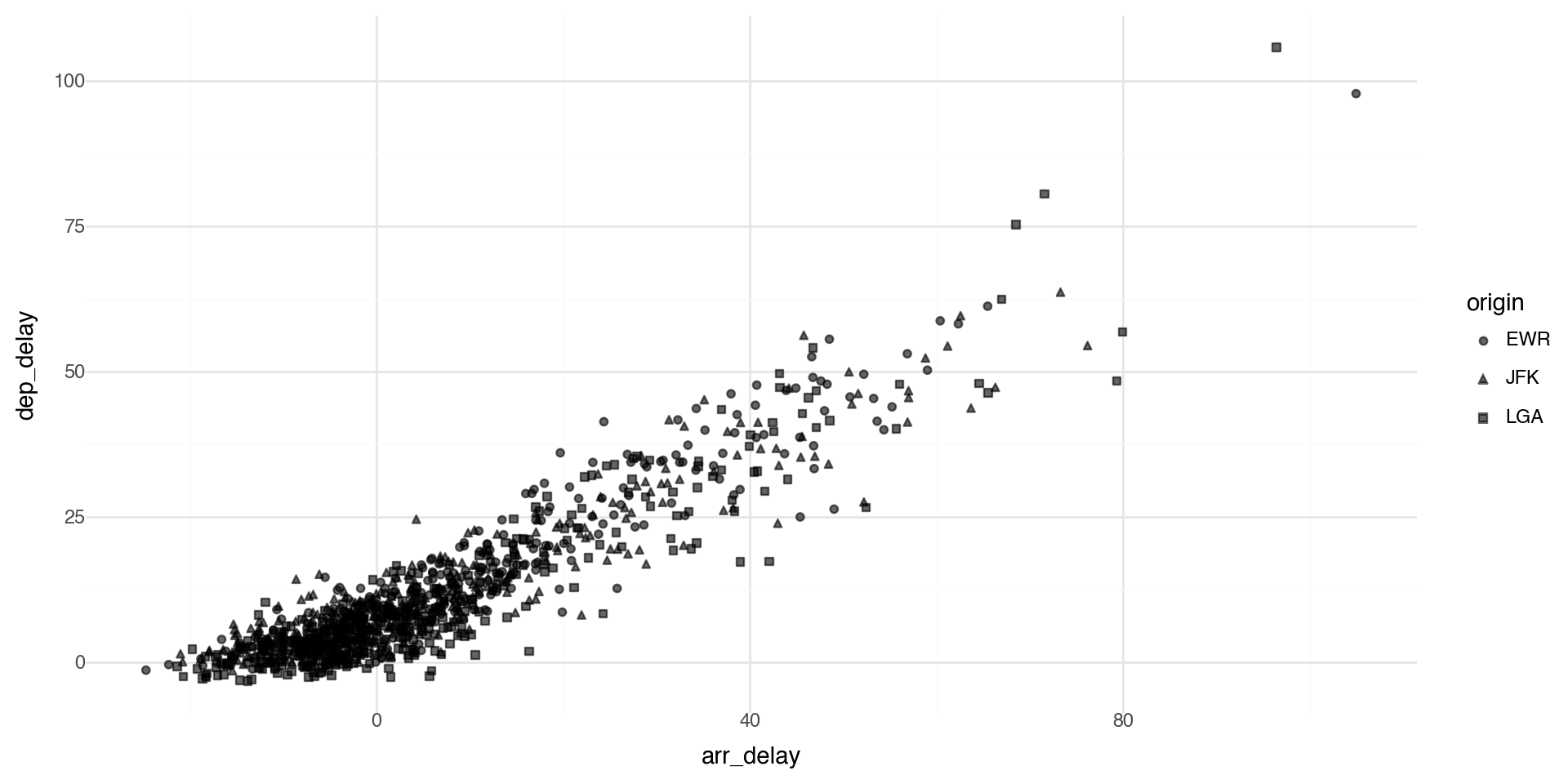
By default plotnine uses up to 6 shapes with shape= in the aes() aesthetics. If there are more, some of your data is not plotted!! (At least it warns you.)

(ggplot(flights_weather_day, aes(x='arr_delay', y='dep_delay', shape='origin')) +
  geom_point(alpha=0.6) +
  theme_minimal())

Manual control of aesthetics

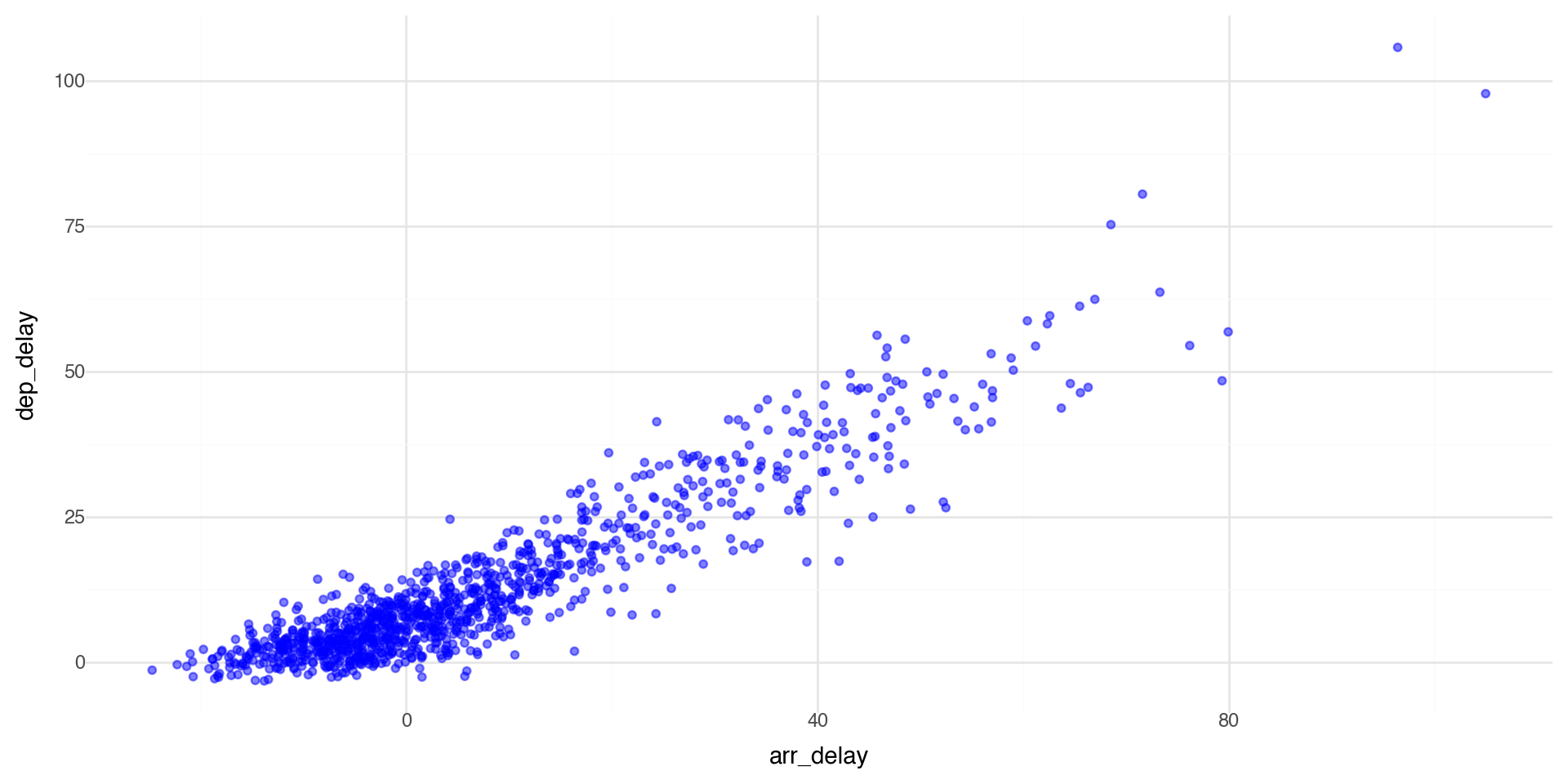
If we control aesthetics manually in the layer such as geom_point() (i.e. outside aes()), they become fixed constants for that geom, not variables mapped from the data.

One more important detail in plotnine: if you write aes(color='blue'), that’s a mapping (to the literal string “blue”), not a fixed aesthetic, so you’ll often get an odd legend. Fixed values should be outside aes(), but coloring by a variable (such as a group) should be inside aes().

(ggplot(flights_weather_day, aes(x='arr_delay', y='dep_delay')) +
  geom_point(color='blue', alpha=0.5) +
  theme_minimal())

Summary of aesthetics

The various aesthetics of aes:

Code Description
x position on x-axis
y position on y-axis
shape shape
color color of element borders
fill color inside elements
size size
alpha transparency
linetype type of line

Facets 1

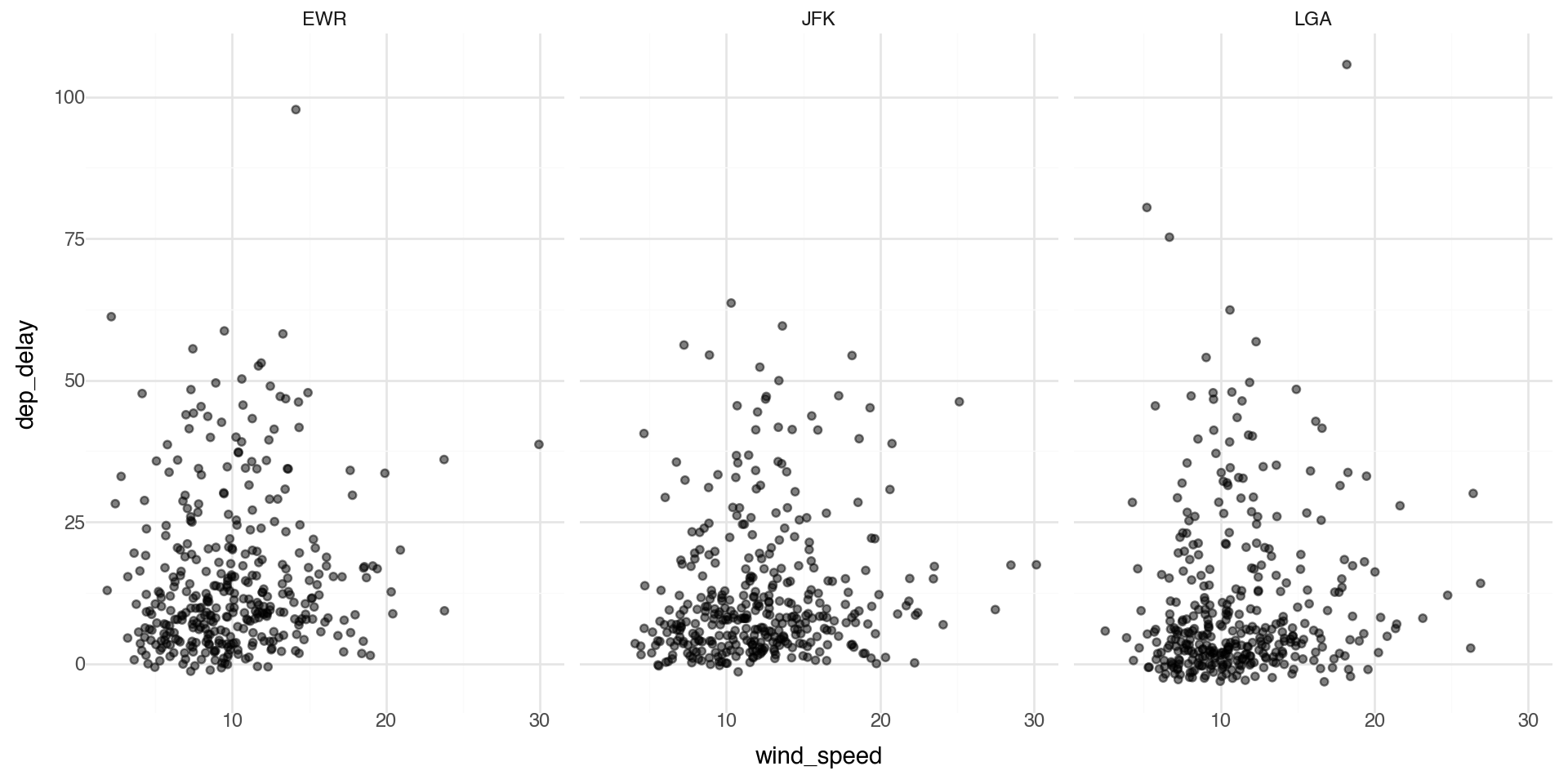
Facets are particularly useful for categorical variables:

(ggplot(flights_weather_day, aes(x='wind_speed', y='dep_delay')) +
  geom_point(alpha=0.5) +
  facet_wrap('~origin', nrow=1) +
  theme_minimal())

Facets 2

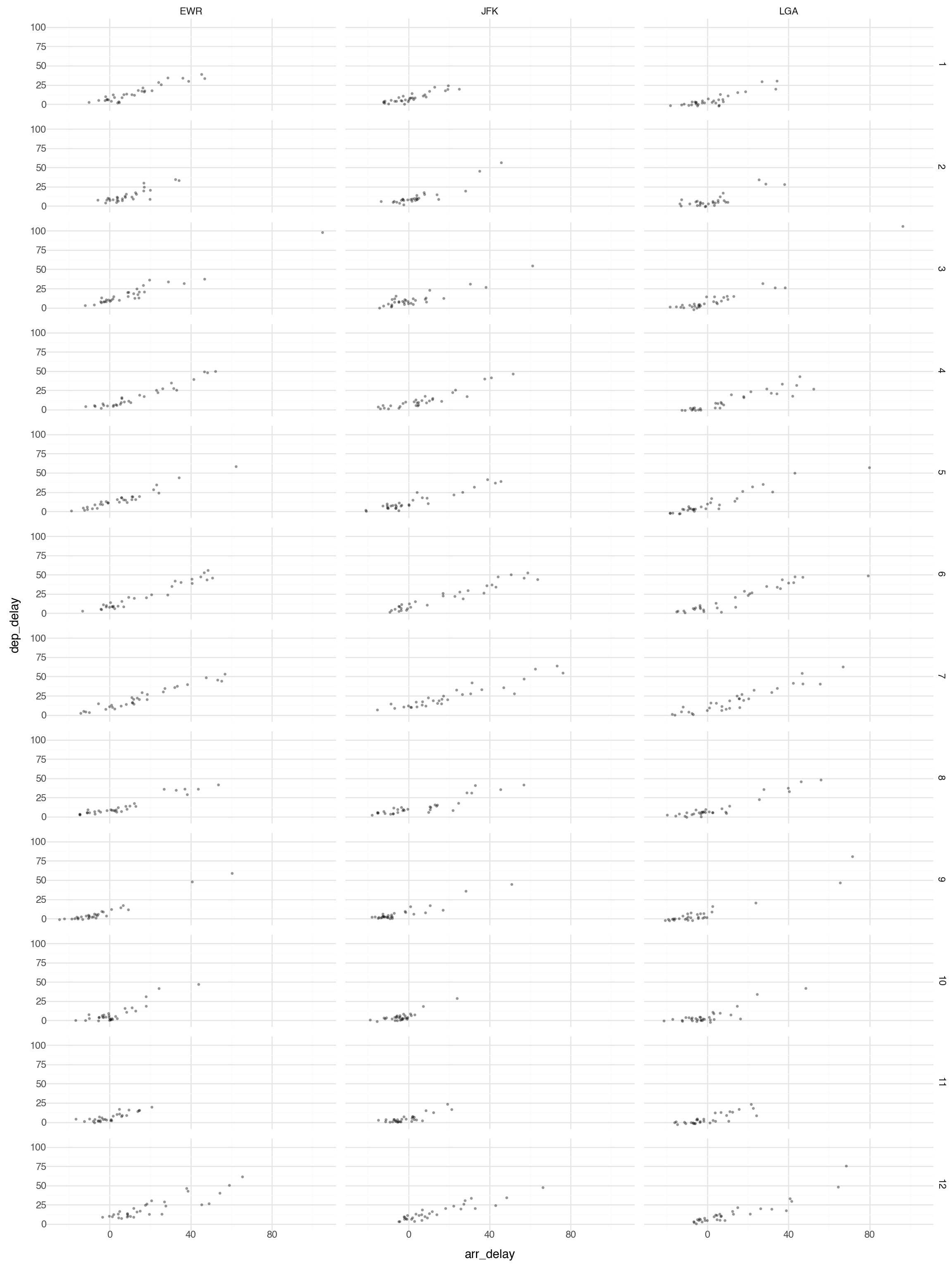
Or you can facet on two variables:

(ggplot(flights_weather_day, aes(x='arr_delay', y='dep_delay')) +
  geom_point(alpha=0.3, size=0.5) +
  facet_grid('month~origin') +
  theme_minimal() +
  theme(figure_size=(12, 16)))

Note this plot is probably too large and busy for practical use, but it gives you the idea what is possible with faceting.

Geometric Objects 1

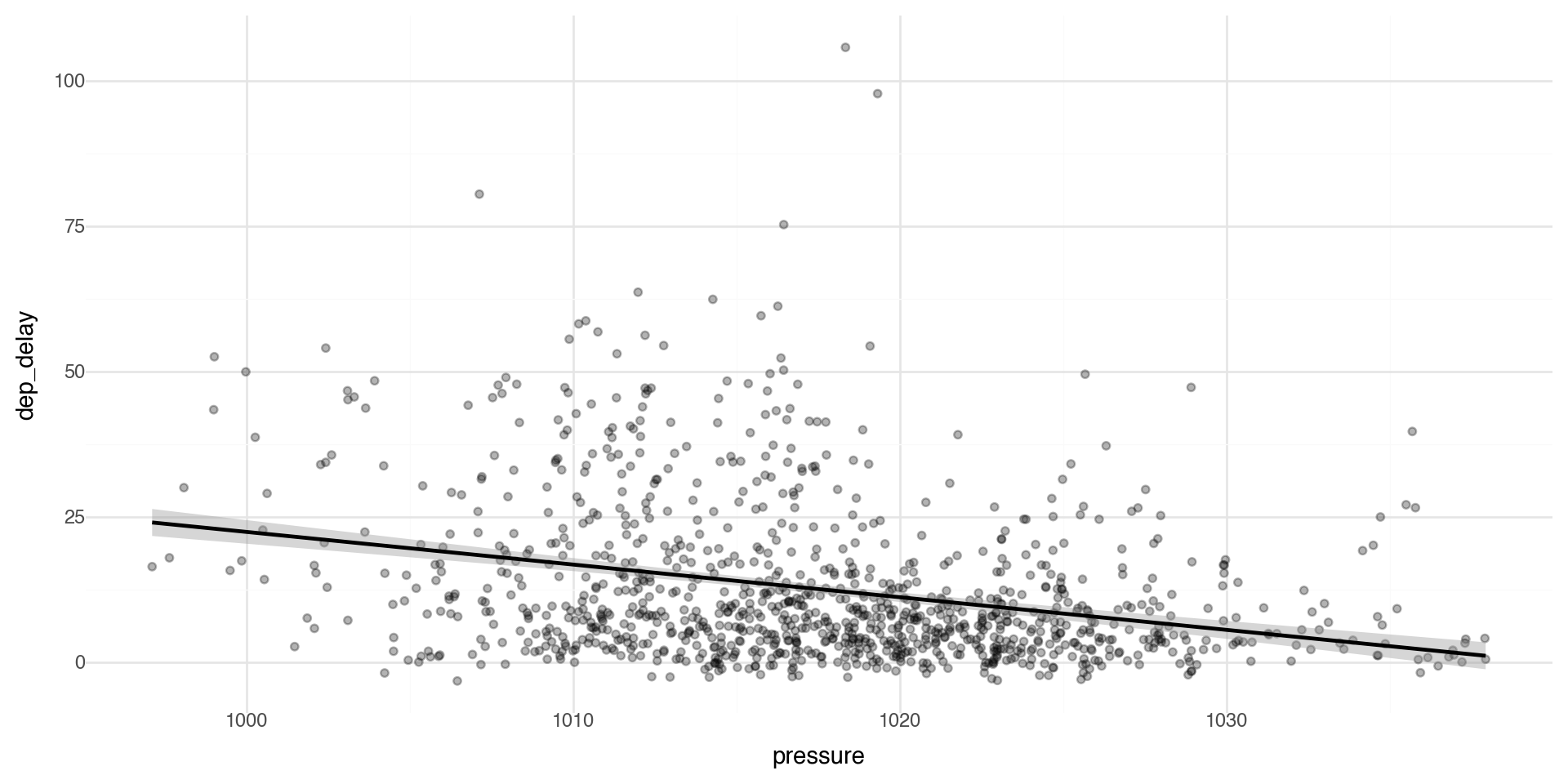
Geometric objects are used to control the type of plot you draw. Let’s plot a smoothed line fitted to the scatterplot data between pressure and departure delay.

(ggplot(flights_weather_day, aes(x='pressure', y='dep_delay')) +
  geom_point(alpha=0.3) +
  geom_smooth() +
  theme_minimal())

Geometric Objects 2

Note that not every aesthetic works with every geom function.

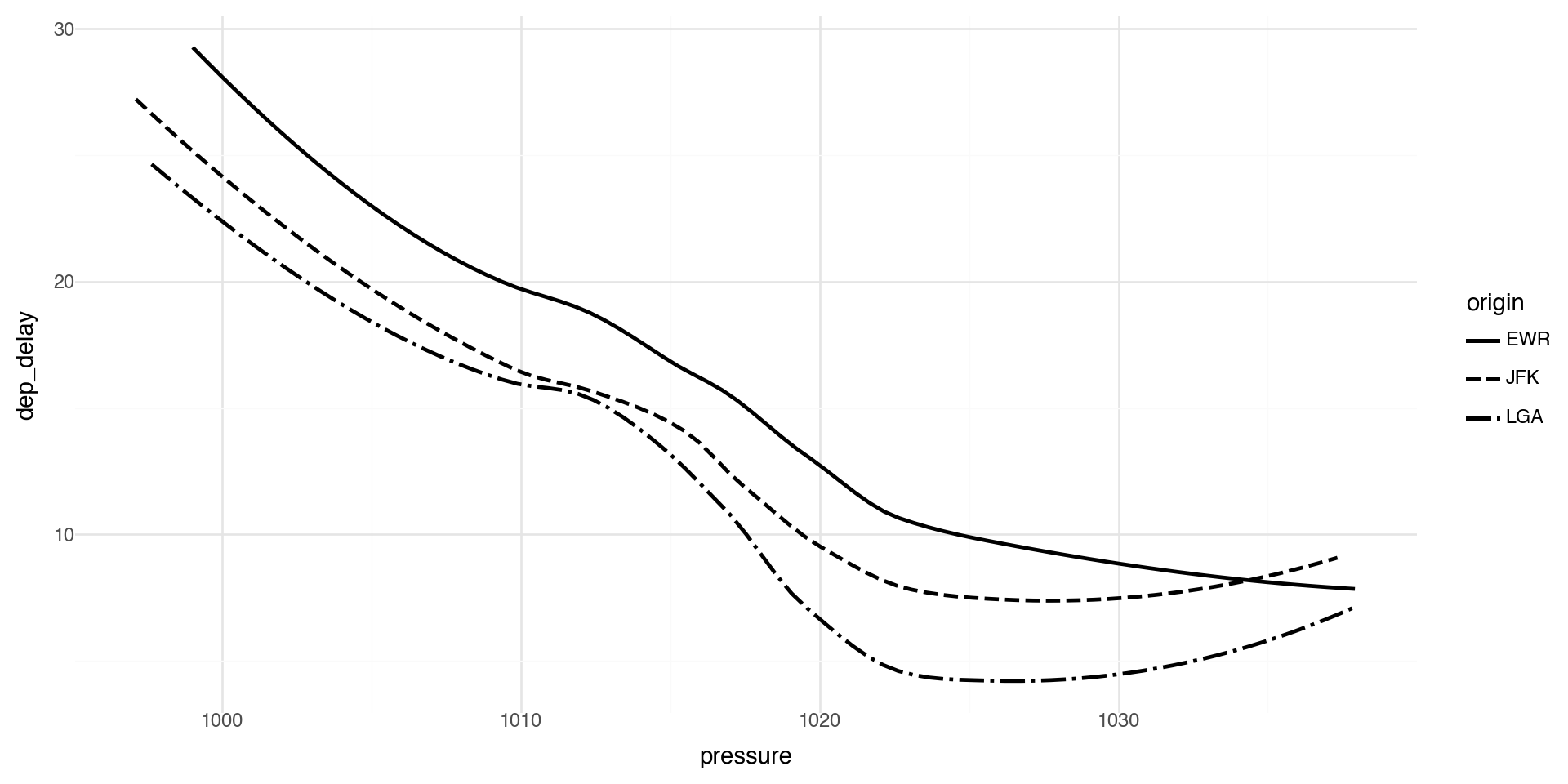
For example, linetype is an aesthetic mapping that controls the pattern used to draw lines (solid, dashed, dotted, etc.).

(ggplot(flights_weather_day, aes(x='pressure', y='dep_delay', linetype='origin')) +
  geom_smooth(se=False) +
  theme_minimal())

Geoms - Reference

plotnine provides many geoms, mirroring ggplot2’s functionality. See https://plotnine.readthedocs.io/ for documentation.

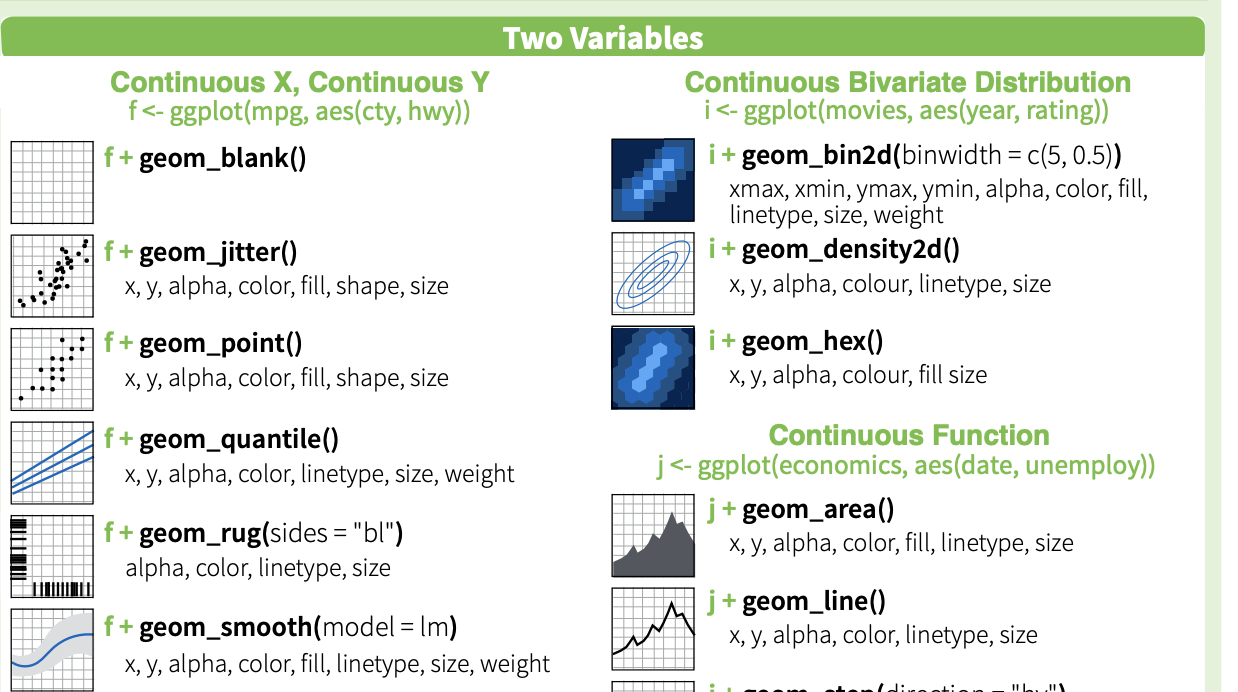
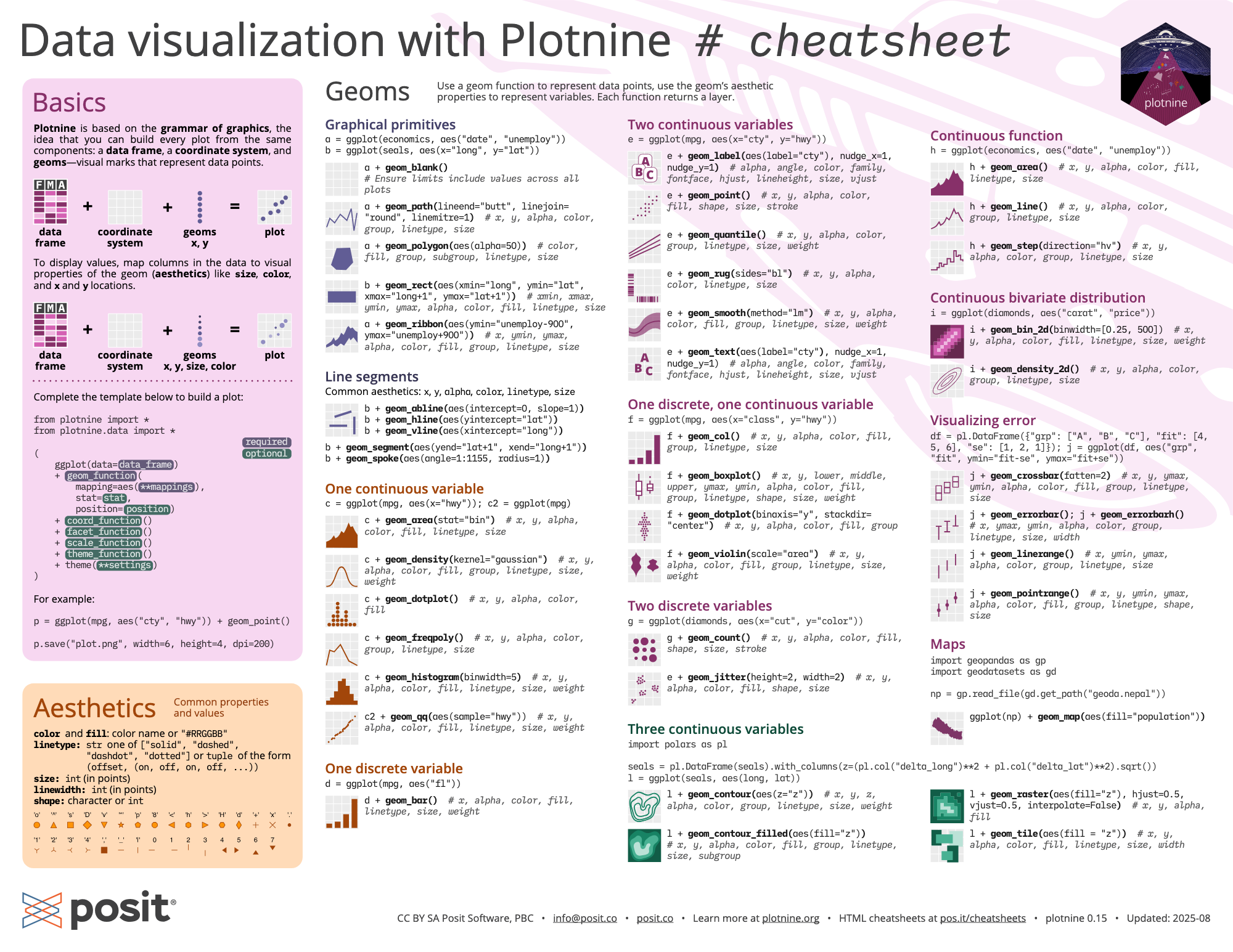
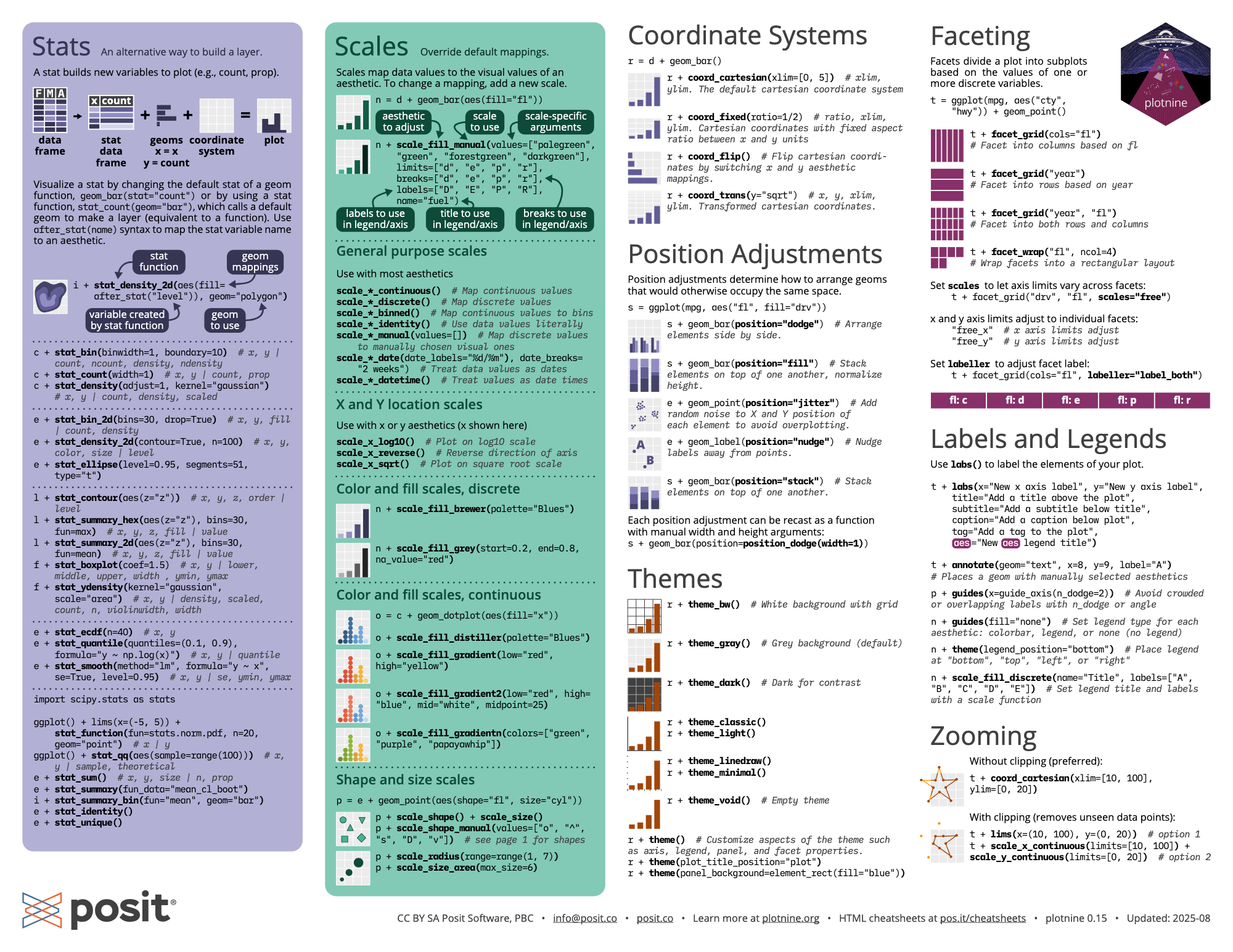
Here is a nice plotnine guide

And cheatsheet (front) and cheatsheet (back)

Multiple Geoms 1

To display multiple geoms in the same plot, add multiple geom functions to ggplot(), for example geom_point and geom_smooth

Multiple Geoms 2

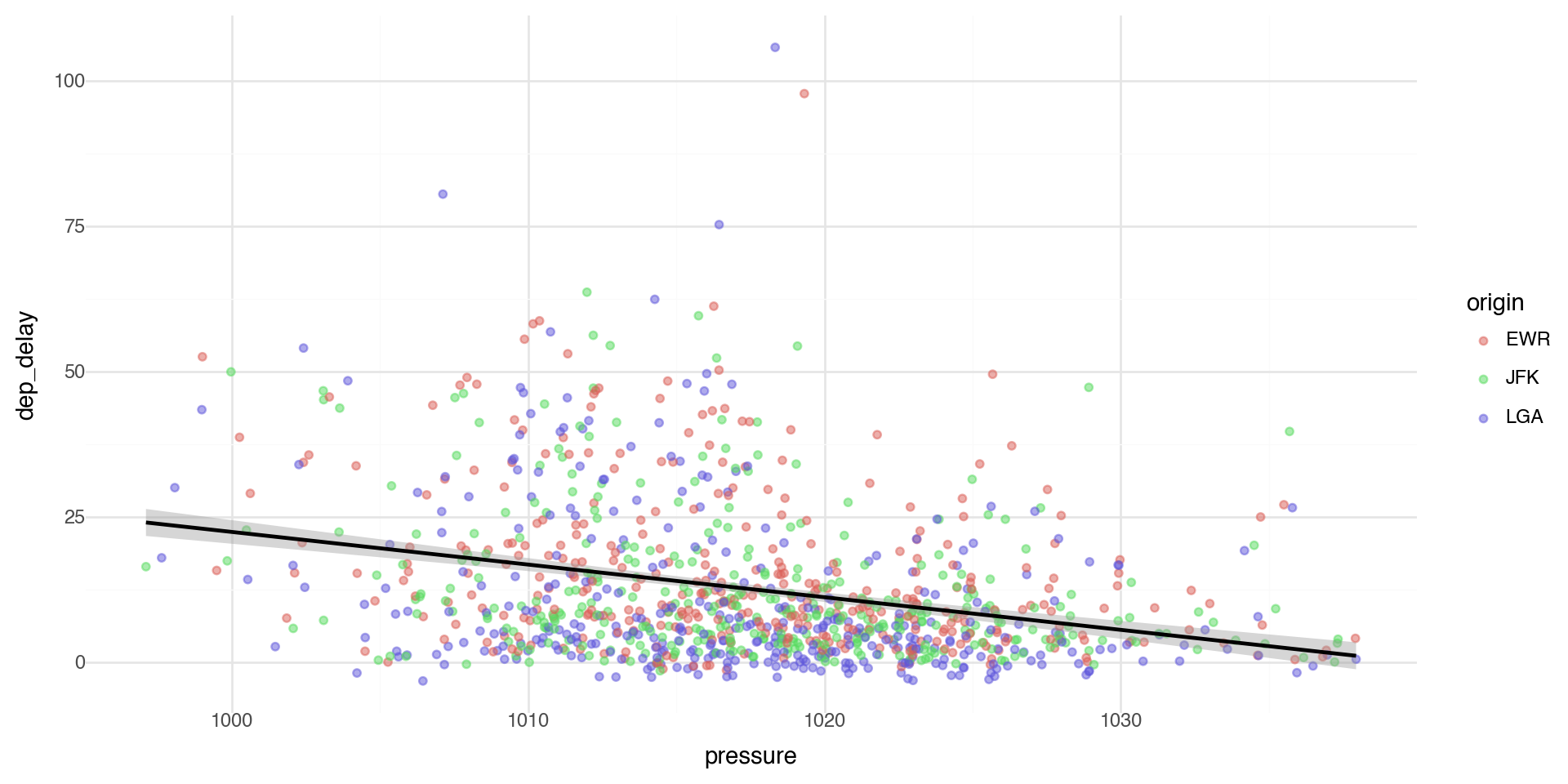
If you place mappings in a geom function, plotnine will use these mappings to extend or overwrite the global mappings for that layer only. This makes it possible to display different aesthetics in different layers.

(ggplot(flights_weather_day, aes(x='pressure', y='dep_delay')) +
  geom_point(aes(color='origin'), alpha=0.5) +
  geom_smooth() +
  theme_minimal())

Multiple Geoms 3

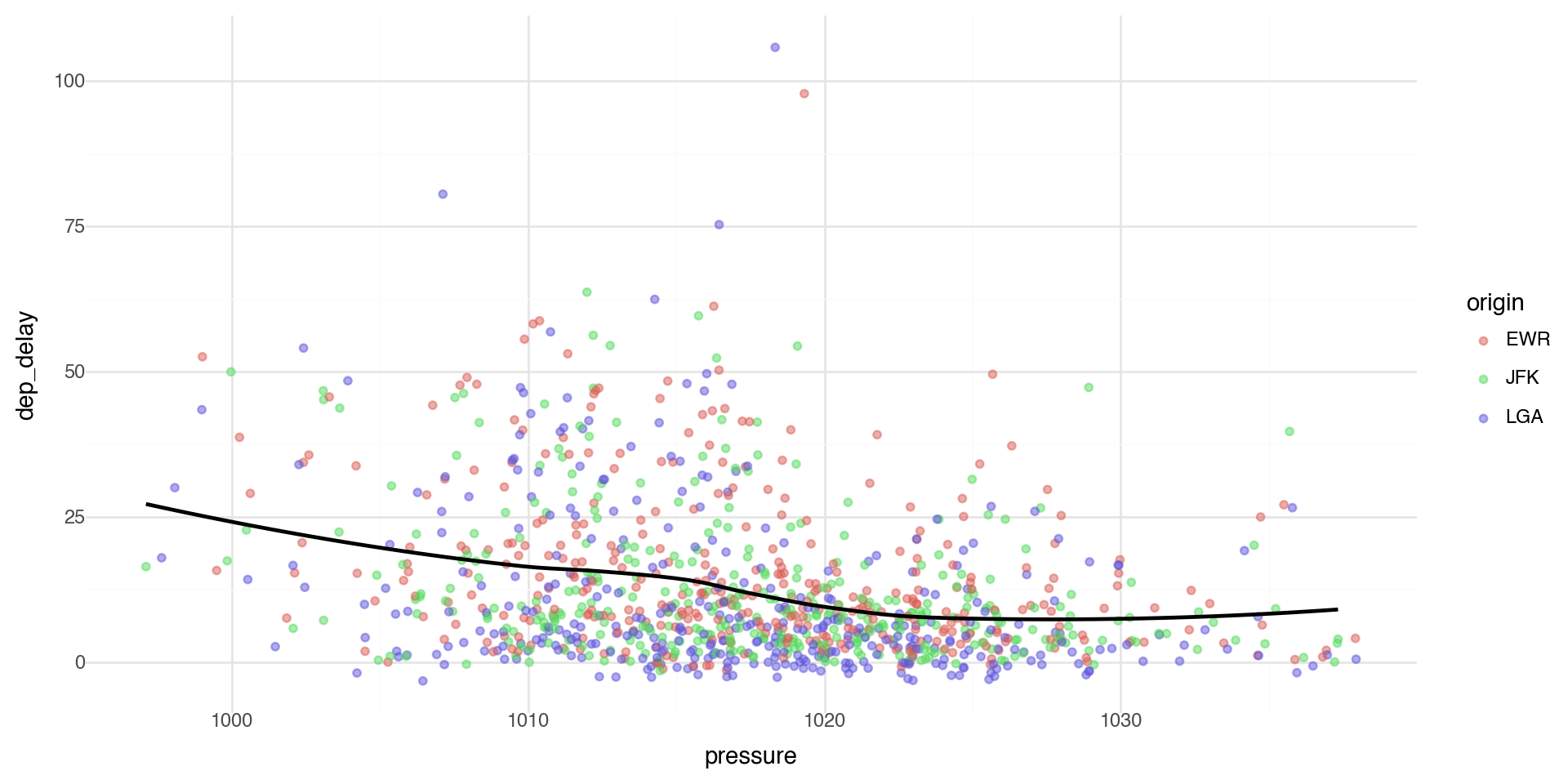
You can use the same idea to specify different data for each layer. Here, our smooth line displays just a subset of the dataset, the flights departing from JFK. The local data argument in geom_smooth() overrides the global data argument in ggplot() for that layer only.

jfk_data = flights_weather_day.query('origin == "JFK"')

(ggplot(flights_weather_day, aes(x='pressure', y='dep_delay')) +
  geom_point(aes(color='origin'), alpha=0.5) +
  geom_smooth(data=jfk_data, se=False, color='black') +
  theme_minimal())

Multiple Geoms 4

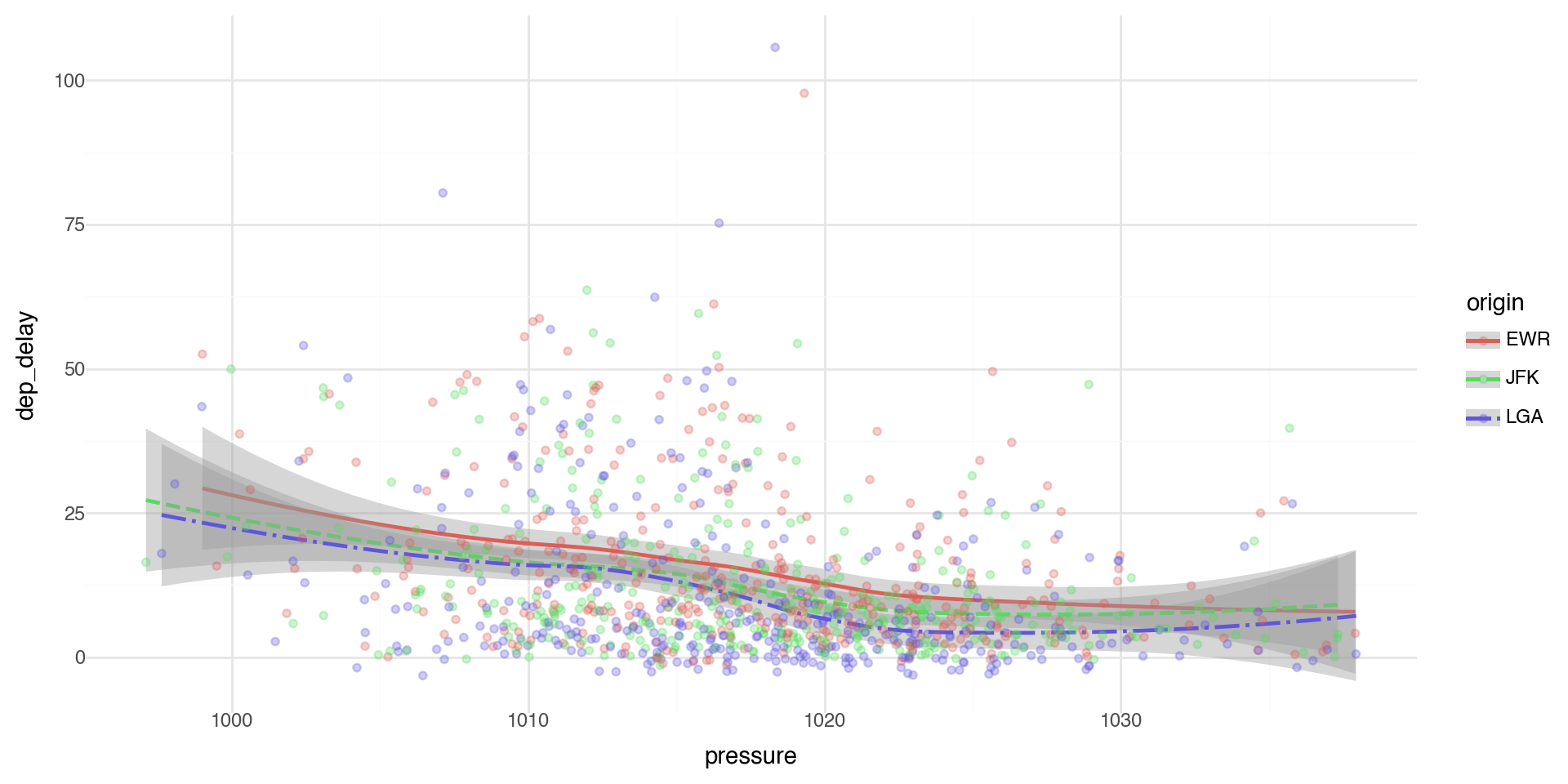
We can layer the points with geom_point and error bars on the geom_smooth.

We can add color and linetype by origin airport.

(ggplot(flights_weather_day, aes(x='pressure', y='dep_delay', linetype='origin',color='origin')) +
  geom_smooth(se=True) +
  geom_point(alpha=0.3) +
  theme_minimal())

Statistical Transformations - e.g. Bar charts

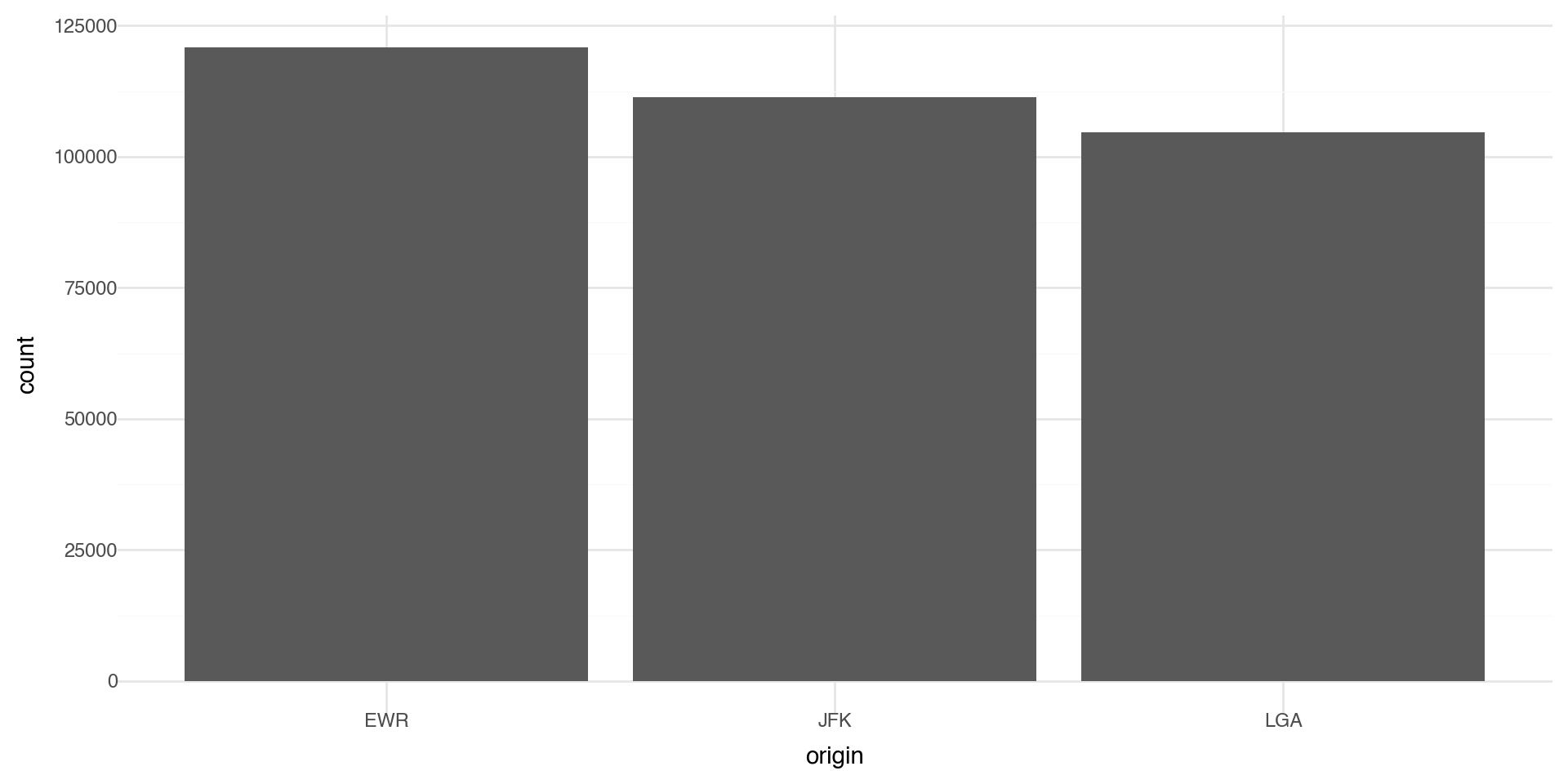
Let’s make a bar chart of the number of flights at each origin airport in 2013. The algorithm uses a built-in statistical transformation, called a “stat”, to calculate the counts.

(ggplot(flights_weather, aes(x='origin')) +
  geom_bar() +
  theme_minimal())

Bar charts 2

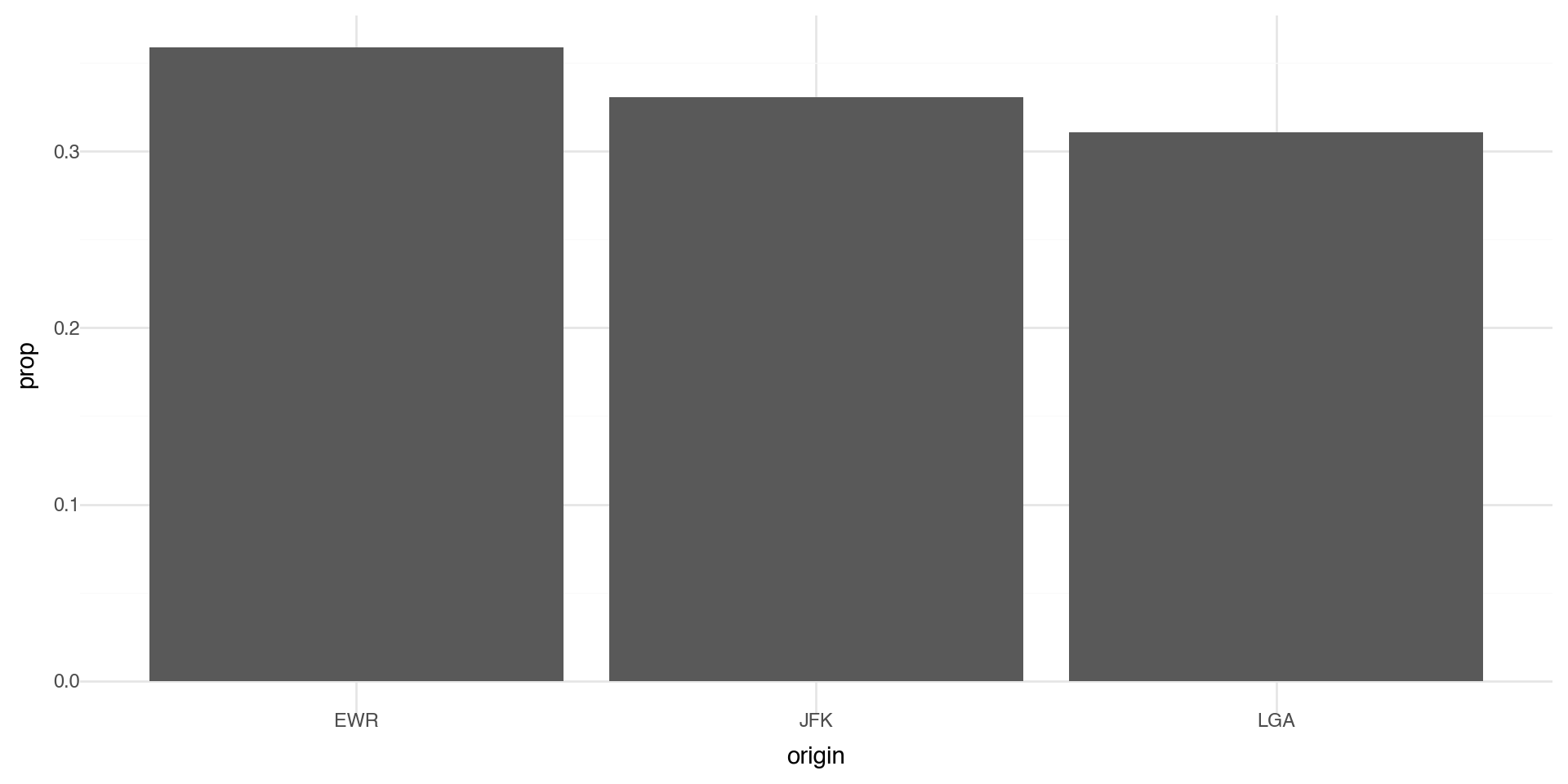
You can override the statistic a geom uses to construct its plot. e.g., if we want to plot proportions, rather than counts:

(ggplot(flights_weather, aes(x='origin', y='..prop..', group=1)) +
  geom_bar() +
  theme_minimal())

Coloring barcharts

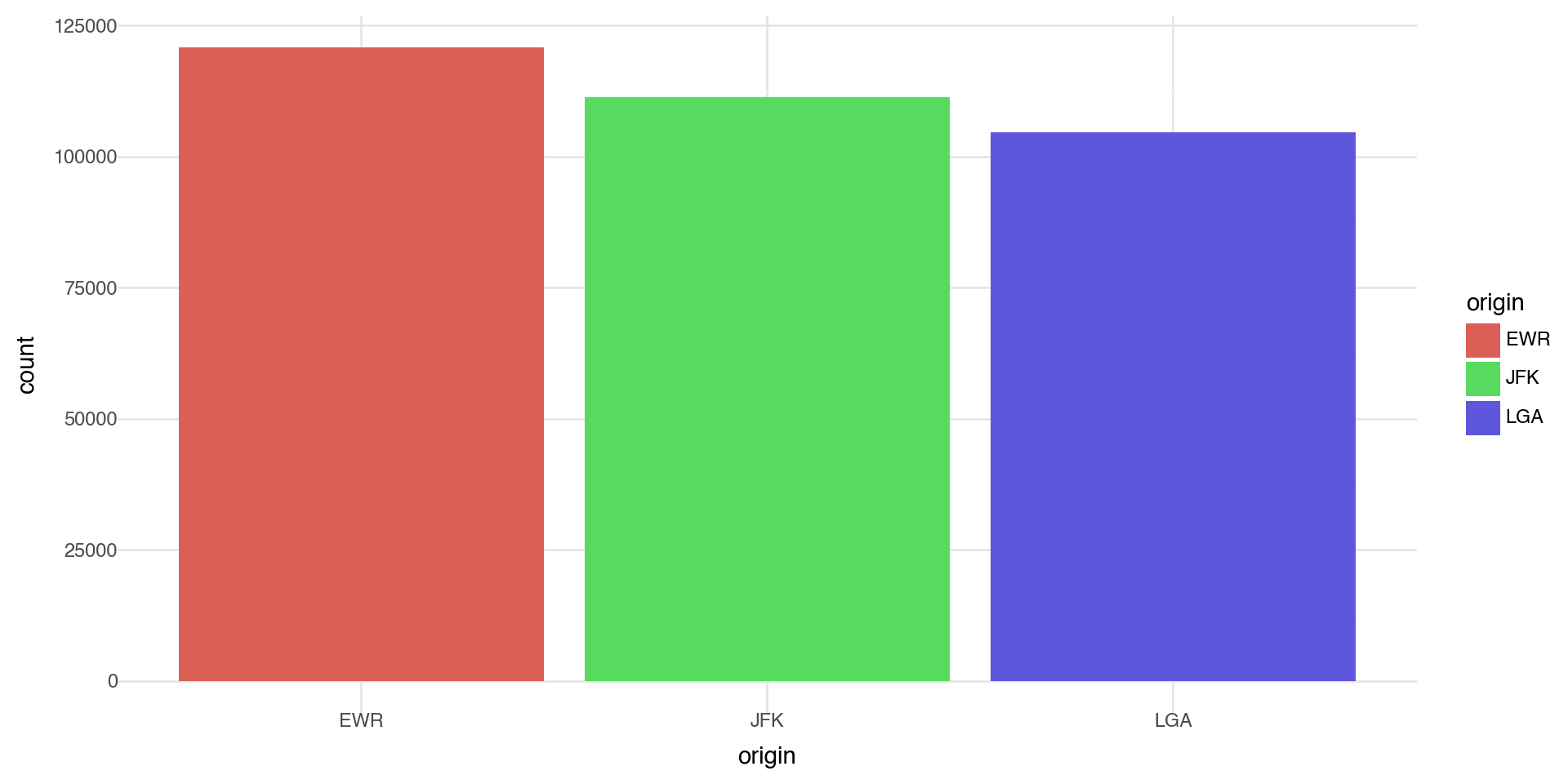
You can color a bar chart using either the color aesthetic (only does the outline), or, more usefully, fill:

(ggplot(flights_weather, aes(x='origin', fill='origin')) +
  geom_bar() +
  theme_minimal())

Coloring barcharts

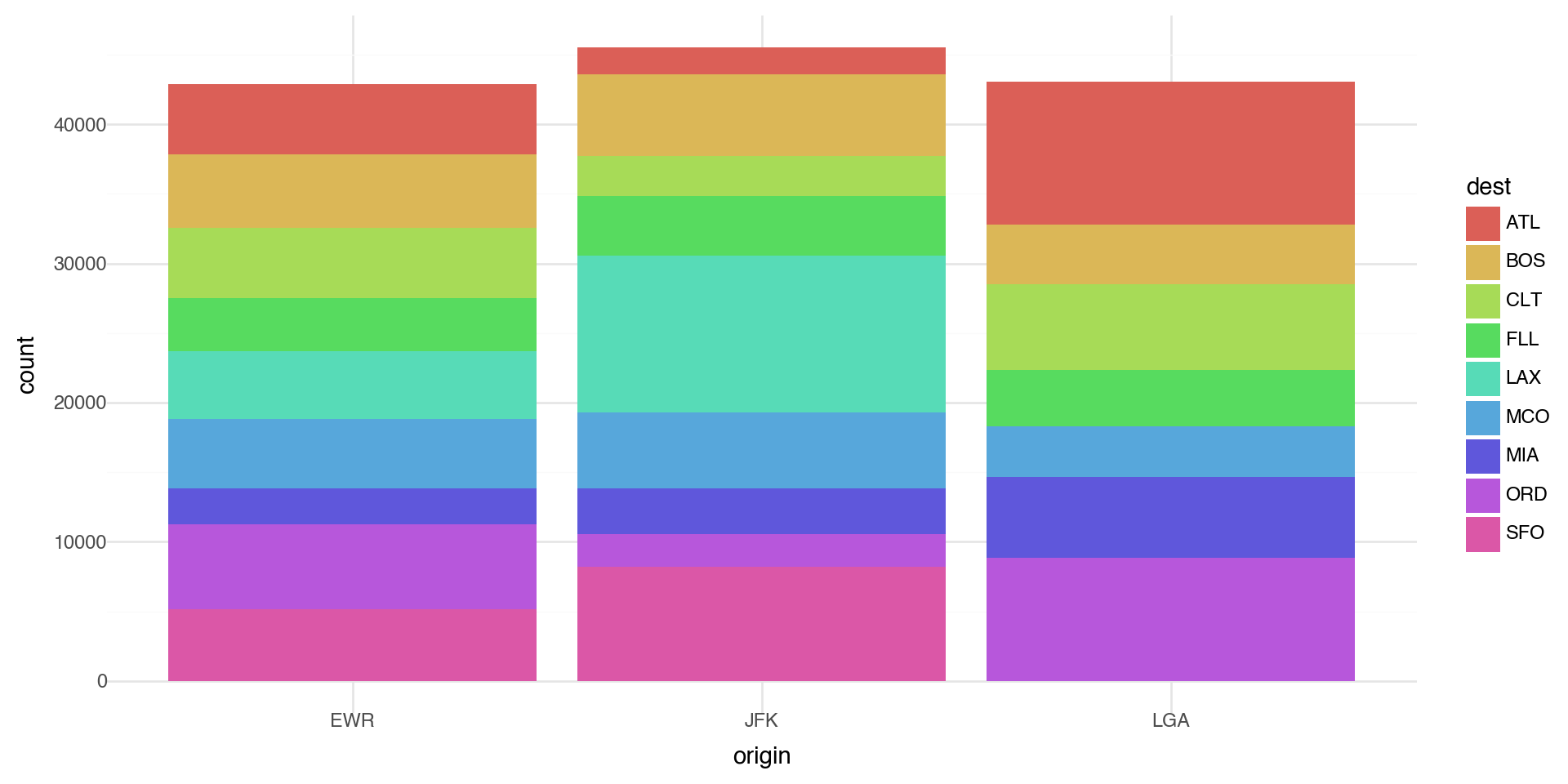
More interestingly, you can fill by another variable. Let’s first subset our data to look at the destination airports with a lot of flights (more than 10,000 flights)

flights_weather_ss = (flights_weather
    .groupby('dest')
    .filter(lambda x: len(x) > 10000))

(ggplot(flights_weather_ss, aes(x='origin', fill='dest')) +
  geom_bar() +
  theme_minimal())

Coloring barcharts

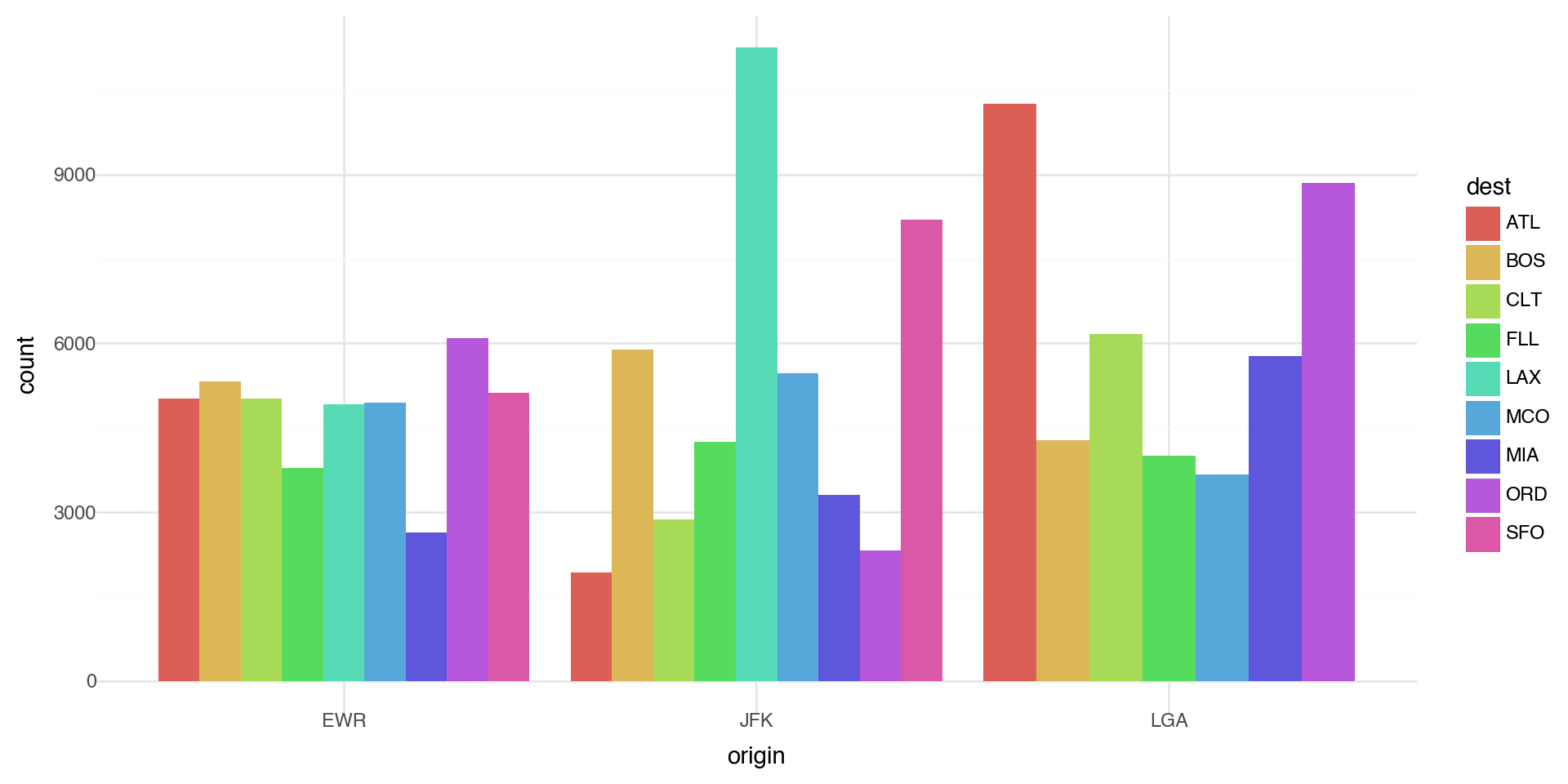
The position='dodge' places overlapping objects directly beside one another. This makes it easier to compare individual values.

(ggplot(flights_weather_ss, aes(x='origin', fill='dest')) +
  geom_bar(position='dodge') +
  theme_minimal())

Statistical transformations - another example

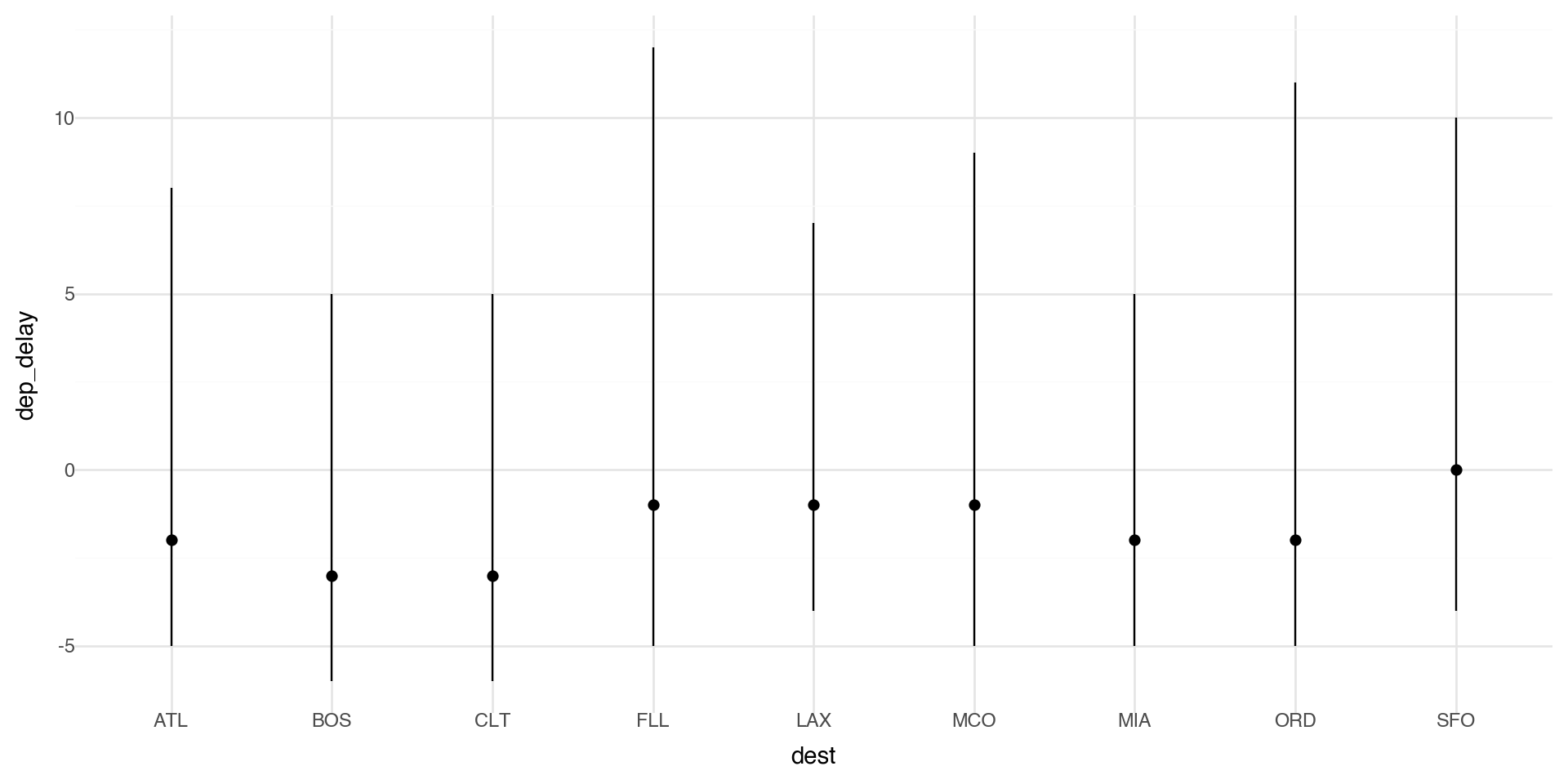
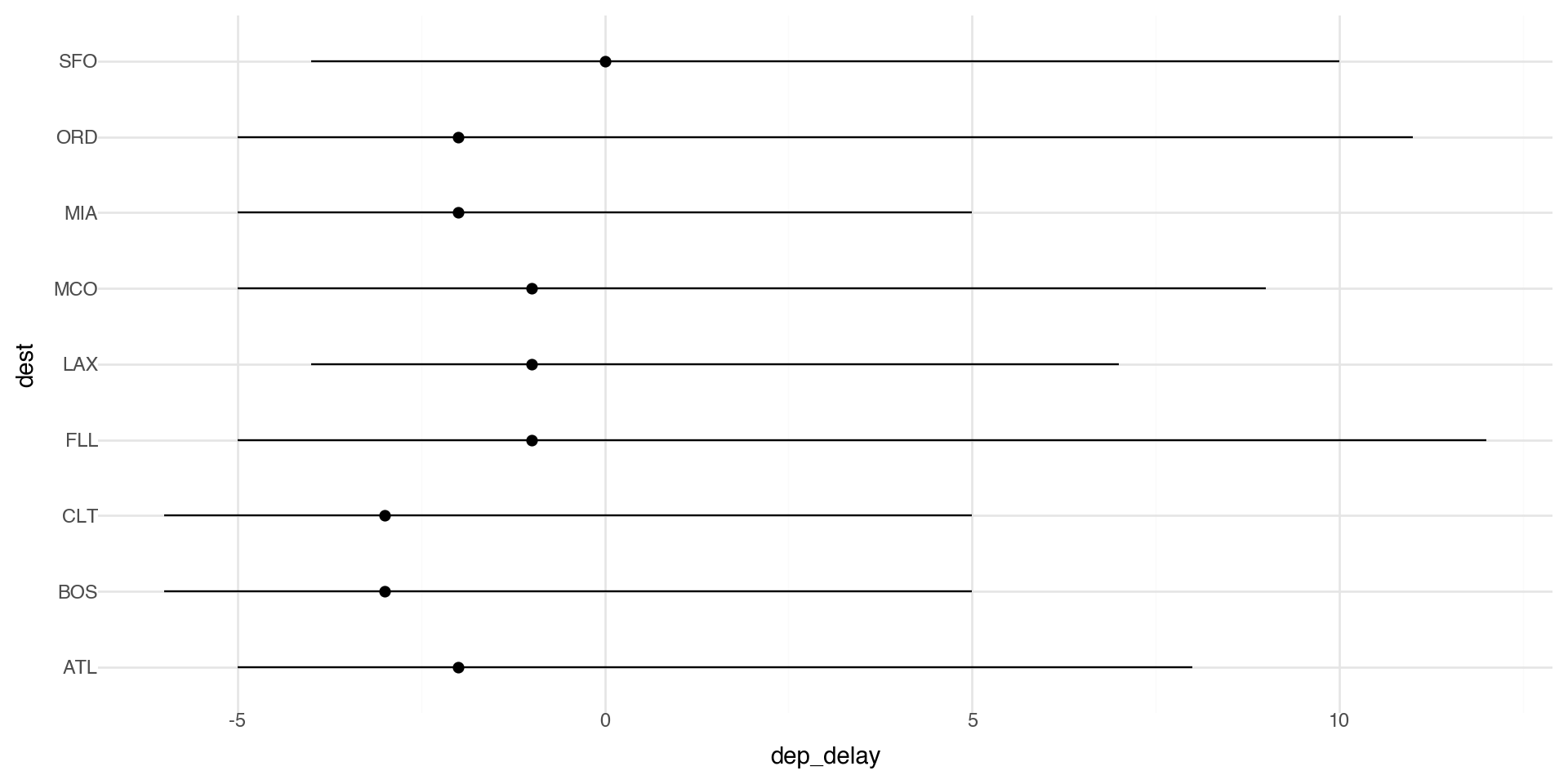
You might want to draw greater attention to the statistical transformation in your code. For example, you might use stat_summary(), which summarizes the y values for each unique x value.

Here we plot the median delay with IQR (25th-75th quantiles) as bars.

(ggplot(flights_weather_ss, aes(x='dest', y='dep_delay')) +
  stat_summary(fun_y=np.median,
               fun_ymin=lambda x: np.percentile(x.dropna(), 25),
               fun_ymax=lambda x: np.percentile(x.dropna(), 75)) +
  theme_minimal())

Coordinate systems

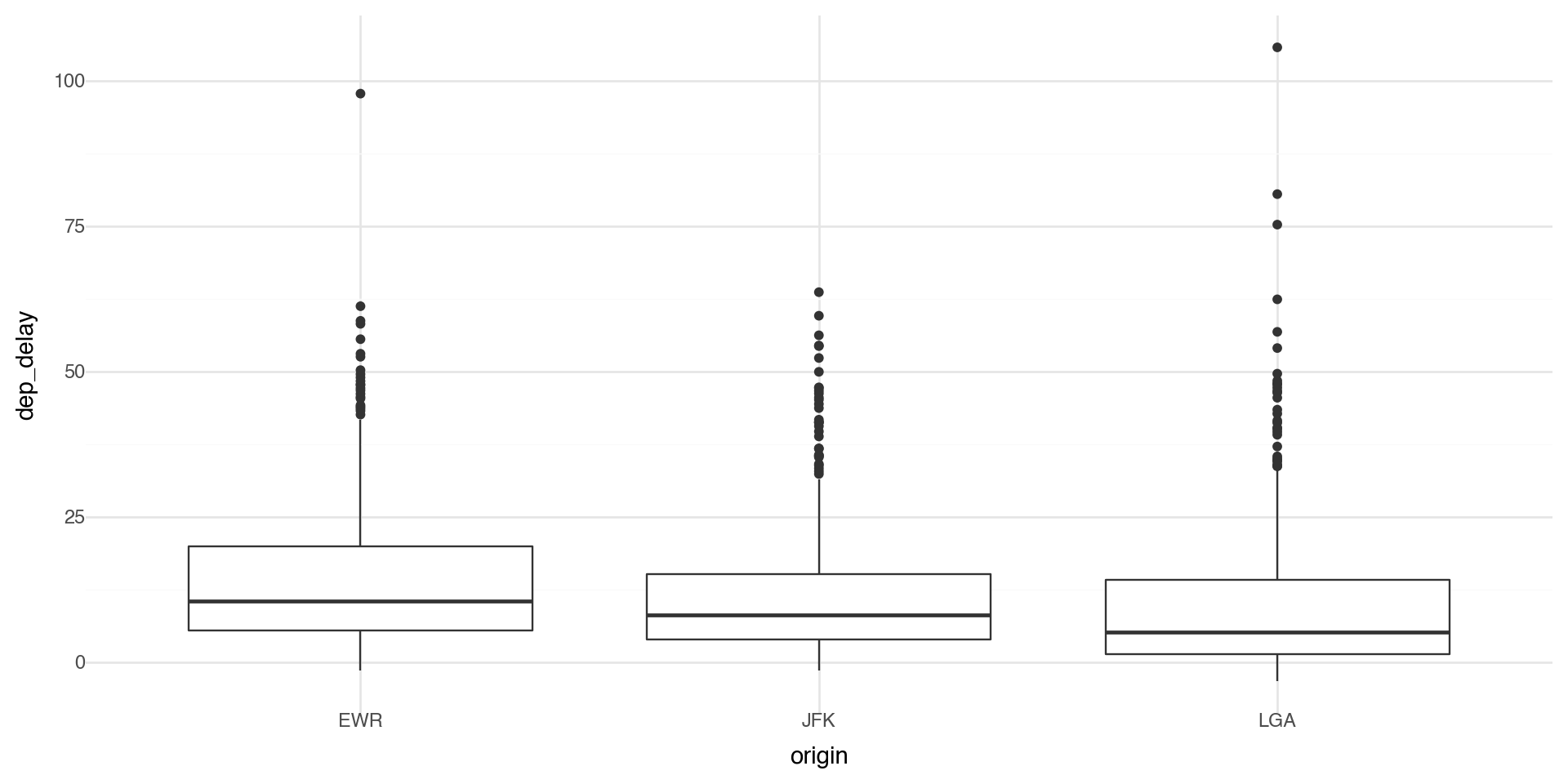
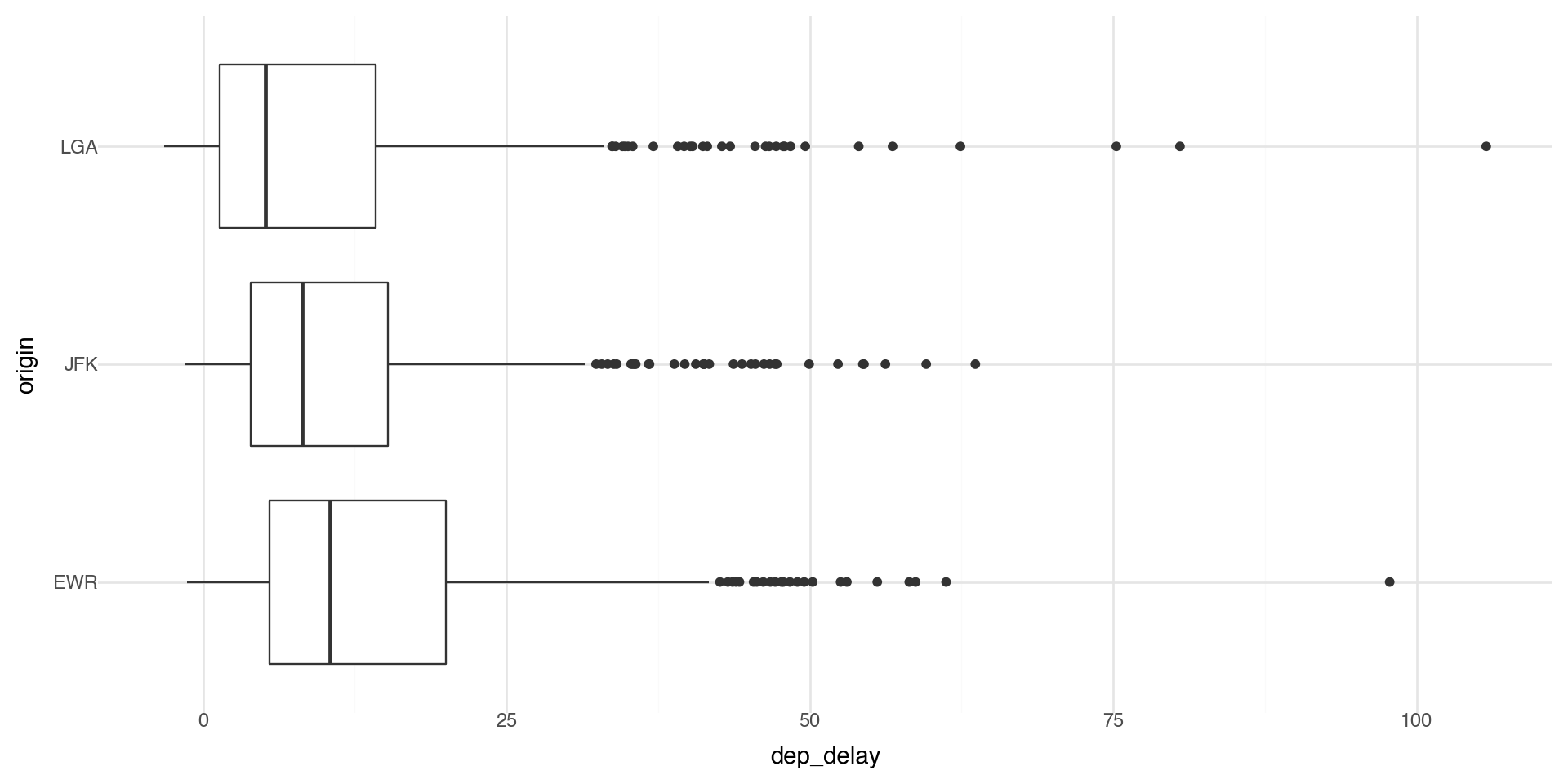
Coordinate systems are one of the more complicated corners of plotnine. To start with something simple, here’s how to flip axes:

# Unflipped
(ggplot(flights_weather_day, aes(x='origin', y='dep_delay')) +
  geom_boxplot() +
  theme_minimal())

# Flipped
(ggplot(flights_weather_day, aes(x='origin', y='dep_delay')) +
  geom_boxplot() +
  coord_flip() +
  theme_minimal())

Coordinate flip the statistical transformation plot

(ggplot(flights_weather_ss, aes(x='dest', y='dep_delay')) +
  stat_summary(fun_y=np.median,
               fun_ymin=lambda x: np.percentile(x.dropna(), 25),
               fun_ymax=lambda x: np.percentile(x.dropna(), 75)) +
  coord_flip() +
  theme_minimal())

Coordinate flip on barplot

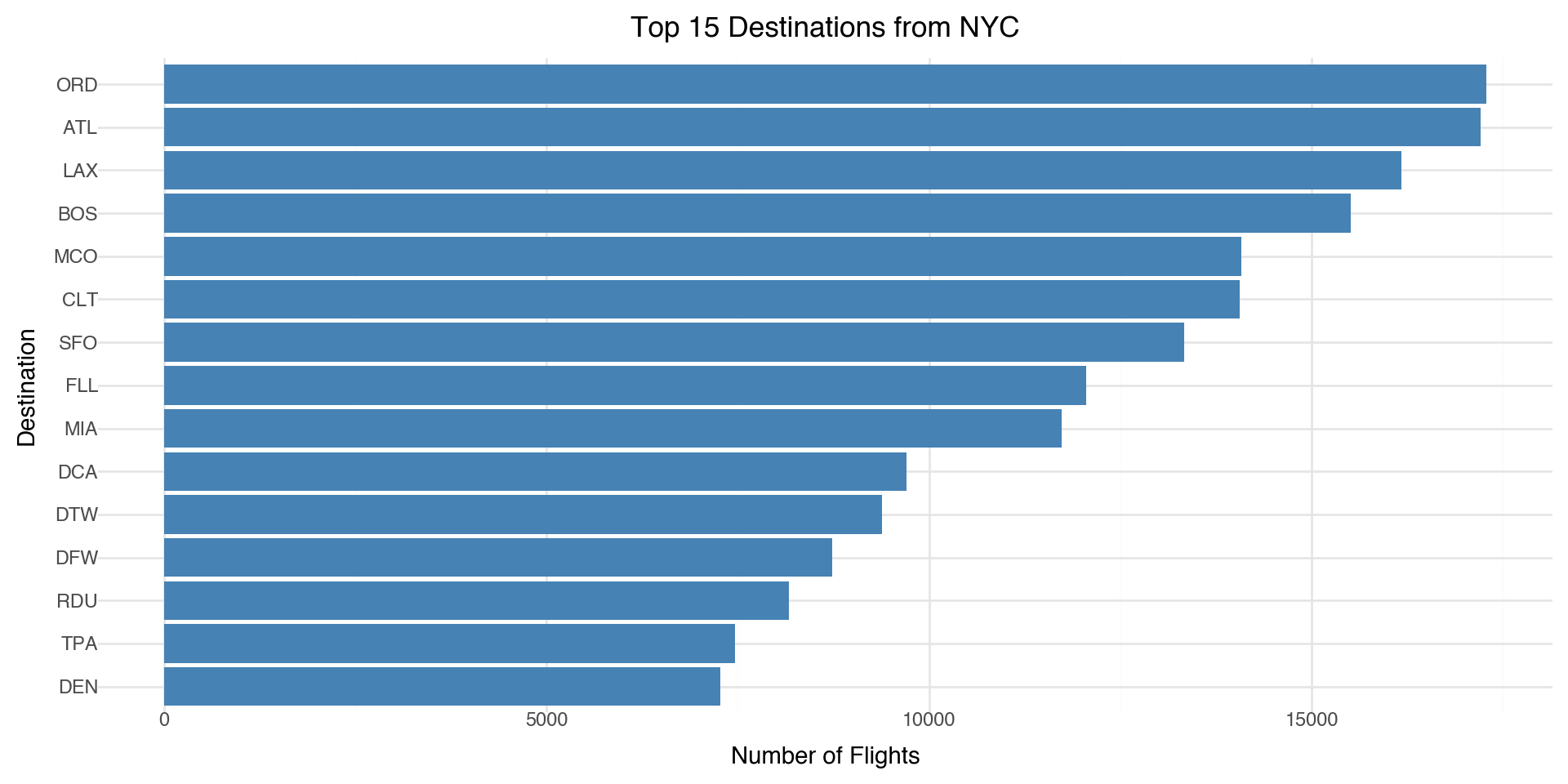
Let’s look at the top destinations from the NYC airports

# Aggregate by destination
top_dests = (flight_routes
    .groupby('dest')['n_flights']
    .sum()
    .sort_values(ascending=False)
    .head(15)
    .reset_index())

(ggplot(top_dests, aes(x='reorder(dest, n_flights)', y='n_flights')) +
  geom_bar(stat='identity', fill='steelblue') +
  coord_flip() +
  labs(x='Destination', y='Number of Flights',
       title='Top 15 Destinations from NYC') +
  theme_minimal())

Coordinate systems

The “easy” ones you’ll use a lot

coord_flip() swaps x and y after the plot is built. Great for boxplots/bar charts to make labels readable.

coord_cartesian(xlim=..., ylim=...) zooms without dropping data (unlike hard limits on scales).

coord_fixed(ratio=1) forces equal aspect ratio (useful for geometry or maps).

Where it gets tricky

  • Stats + coords interactions: some geoms/stats compute first, then coords transform. Most of the time that’s fine, but it can surprise you when you expect “compute in the new coordinate system.”

  • Limits behavior:

    • scale_*_continuous(limits=...) can drop data before statistics are computed.
    • coord_cartesian(...) usually keeps the data and just zooms the view.
    • Non-Cartesian coords (if you use them): e.g., coord_polar() changes the whole geometry, so not every plot makes sense there.

Color ramps

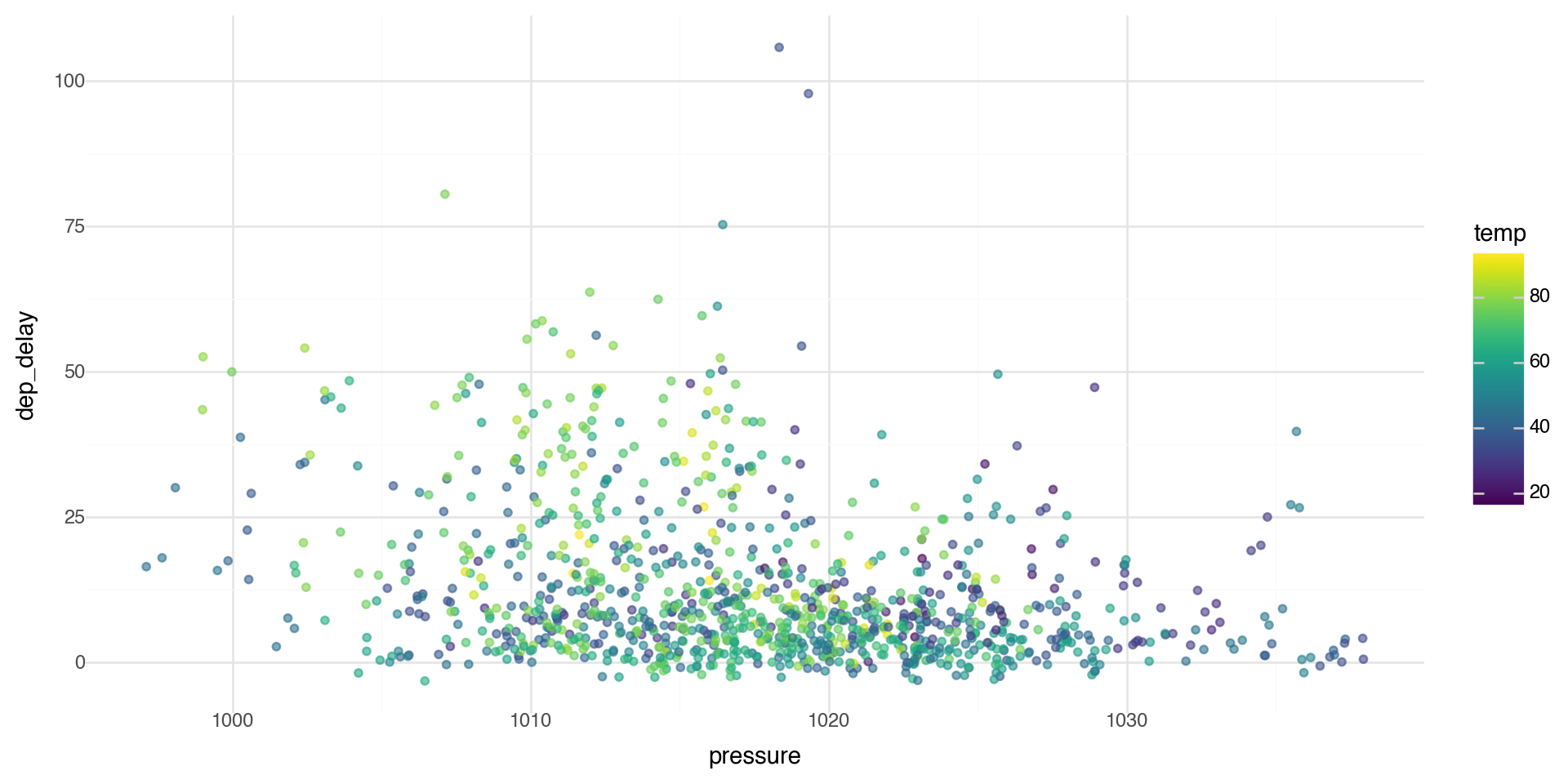
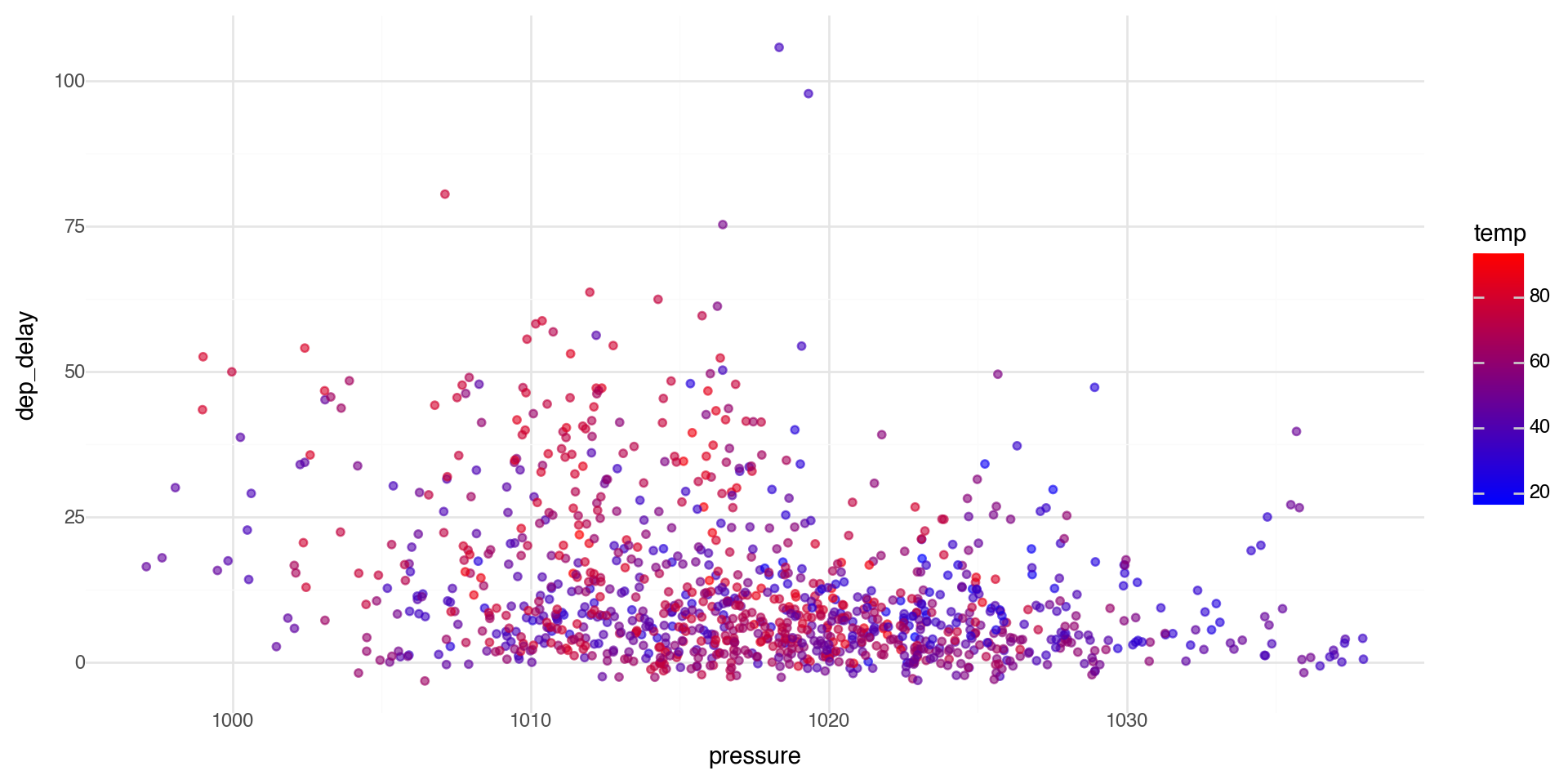
If you add a continuous variable in your color aesthetic, it will create a color ramp. Here we apply color with the variable temp.

(ggplot(flights_weather_day, aes(x='pressure', y='dep_delay')) +
  geom_point(aes(color='temp'), alpha=0.6) +
  theme_minimal())

Color palettes

You can define your own color ramp or use one of the palettes. Here we manually change the color palette with scale_color_gradient.

(ggplot(flights_weather_day, aes(x='pressure', y='dep_delay')) +
  geom_point(aes(color='temp'), alpha=0.6) +
  scale_color_gradient(low='blue', high='red') +
  theme_minimal())

Color palettes

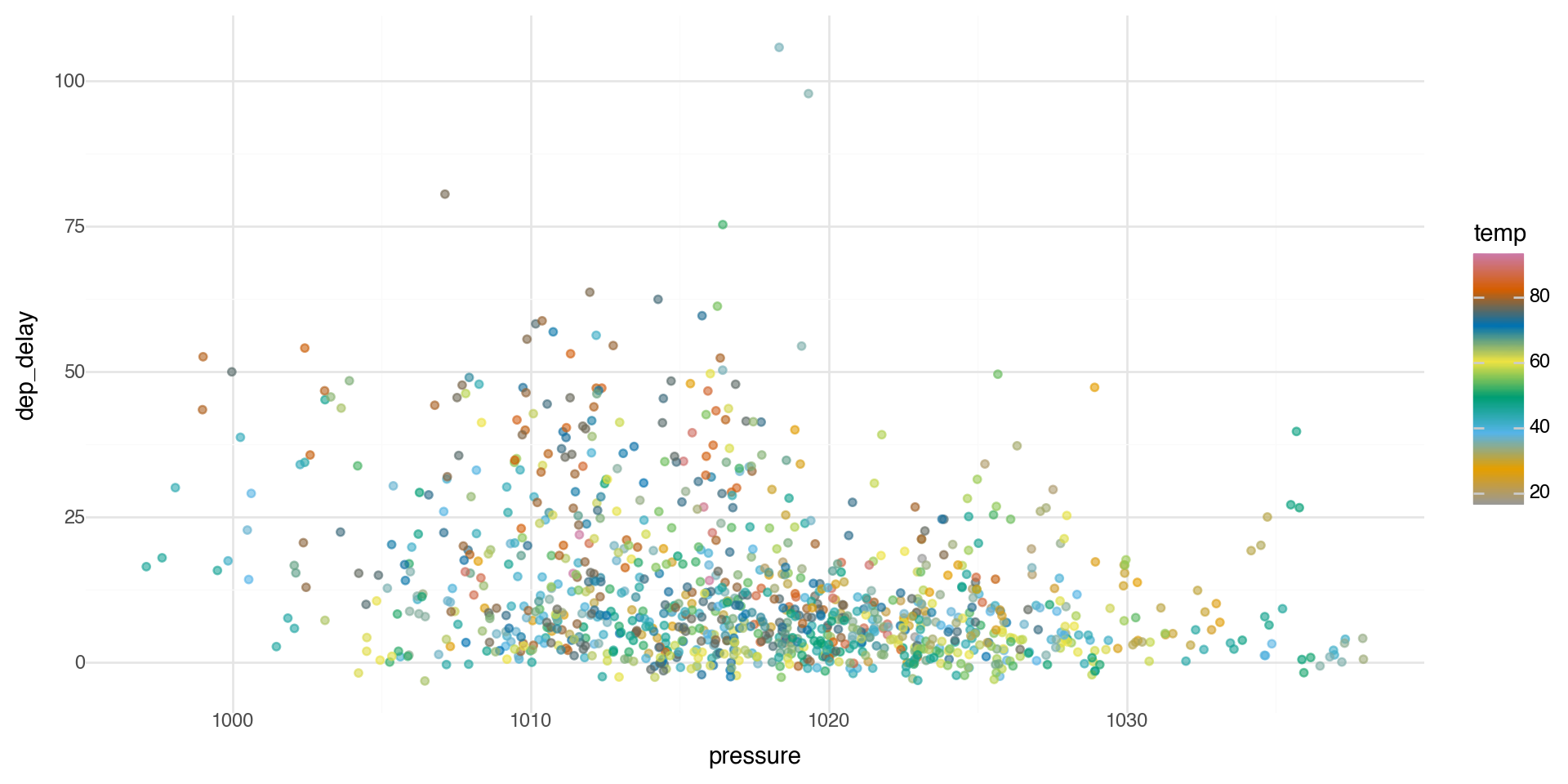
You can get as detailed as you would like for the color ramp.

(ggplot(flights_weather_day, aes(x='pressure', y='dep_delay')) +
  geom_point(aes(color='temp'), alpha=0.6) +
  scale_color_gradientn(colors=['#999999', '#E69F00', '#56B4E9', '#009E73', '#F0E442', '#0072B2', '#D55E00', '#CC79A7']) +
  theme_minimal())

Summary: R to Python Translation

For those of you who have used tidyverse and ggplot in R and want to compare to Python’s pandas/plotnine:

R (tidyverse/ggplot2) Python (pandas/plotnine)
library(ggplot2) from plotnine import *
%>% or |> Method chaining with .
filter() .query() or boolean indexing
group_by() .groupby()
summarize() .agg()
left_join() pd.merge(how='left')
aes(x = var) aes(x='var')

Smooth Regression and GAMs

What is geom_smooth() actually doing?

When we use geom_smooth() in plotnine, we’re fitting a smooth regression line to our data.

  • By default, geom_smooth() uses LOWESS (Locally Weighted Scatterplot Smoothing) for small datasets
  • For larger datasets, it uses a GAM (Generalized Additive Model)
  • The smooth line adapts to the local structure of the data

This raises a question: How do we model non-linear relationships?

The Problem with Linear Models

As we know, a linear model tries to fit the best straight line through the data.

\[y = \beta_0 + \beta_1 x + \epsilon\]

  • This works well when the relationship is actually linear
  • But many real-world relationships are non-linear
  • Forcing a straight line through curved data gives poor predictions

Motivating Example: CO₂ Data

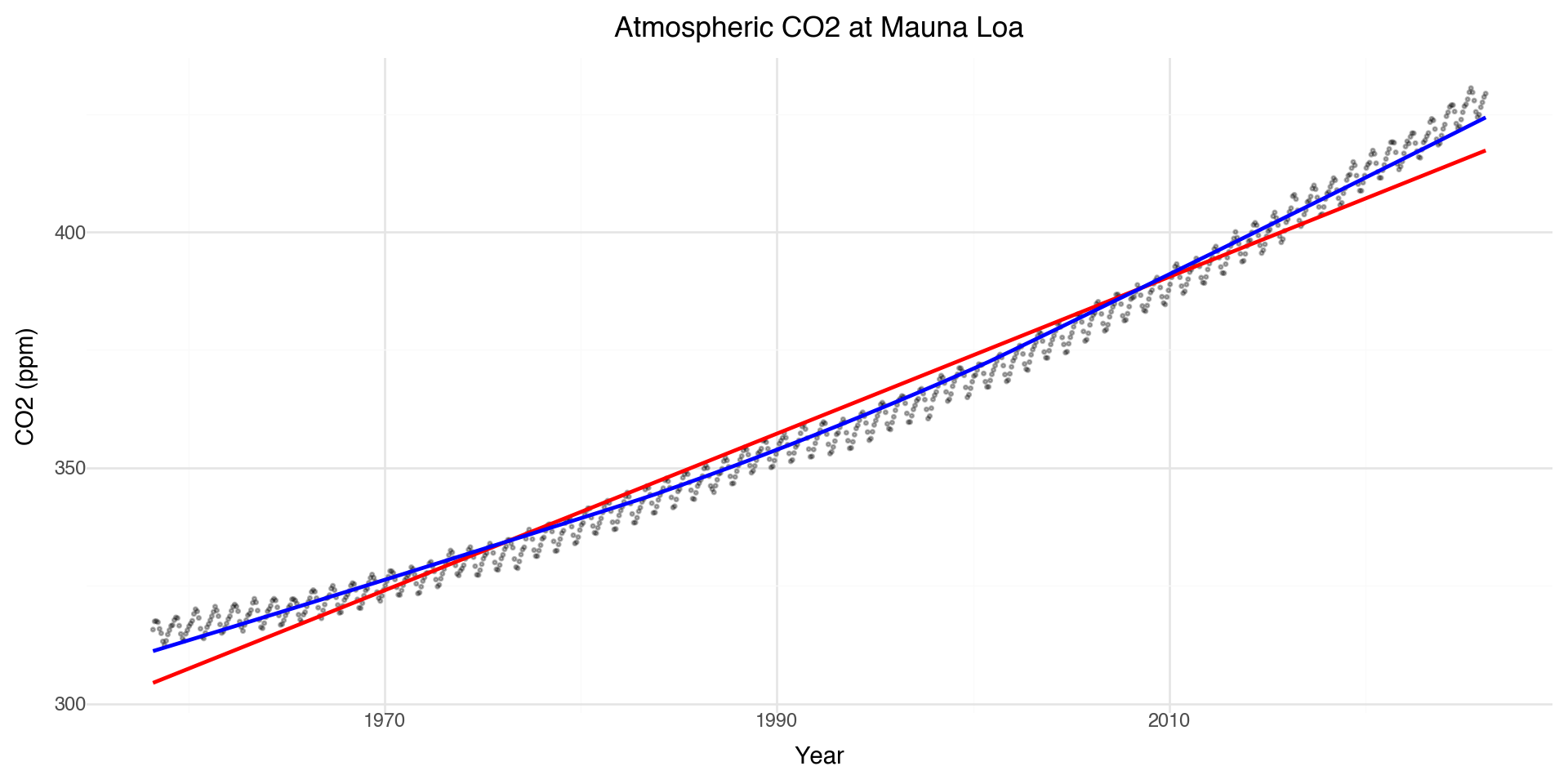
Let’s look at atmospheric CO\(_2\) measurements from Mauna Loa, Hawaii (collected since 1958).

# Load CO2 data
import pandas as pd

url = "https://gml.noaa.gov/webdata/ccgg/trends/co2/co2_mm_mlo.csv"

co2 = pd.read_csv(url, comment="#")  # ignores the metadata header
co2 = co2.rename(columns={"average": "co2"})
co2["month_year"] = pd.to_datetime(co2[["year", "month"]].assign(day=1))

co2.head()
year month decimal date co2 deseasonalized ndays sdev unc month_year
0 1958 3 1958.2027 315.71 314.44 -1 -9.99 -0.99 1958-03-01
1 1958 4 1958.2877 317.45 315.16 -1 -9.99 -0.99 1958-04-01
2 1958 5 1958.3699 317.51 314.69 -1 -9.99 -0.99 1958-05-01
3 1958 6 1958.4548 317.27 315.15 -1 -9.99 -0.99 1958-06-01
4 1958 7 1958.5370 315.87 315.20 -1 -9.99 -0.99 1958-07-01

Linear vs Smooth Fit

(ggplot(co2, aes(x='decimal date', y='co2')) +
  geom_point(alpha=0.3, size=0.5) +
  geom_smooth(method='lm', color='red', se=False) +
  geom_smooth(method='lowess', color='blue', se=False) +
  labs(x='Year', y='CO2 (ppm)',
       title='Atmospheric CO2 at Mauna Loa') +
  theme_minimal())

The linear model misses the curvature and seasonal cycles!

Zooming in: 2025 Data

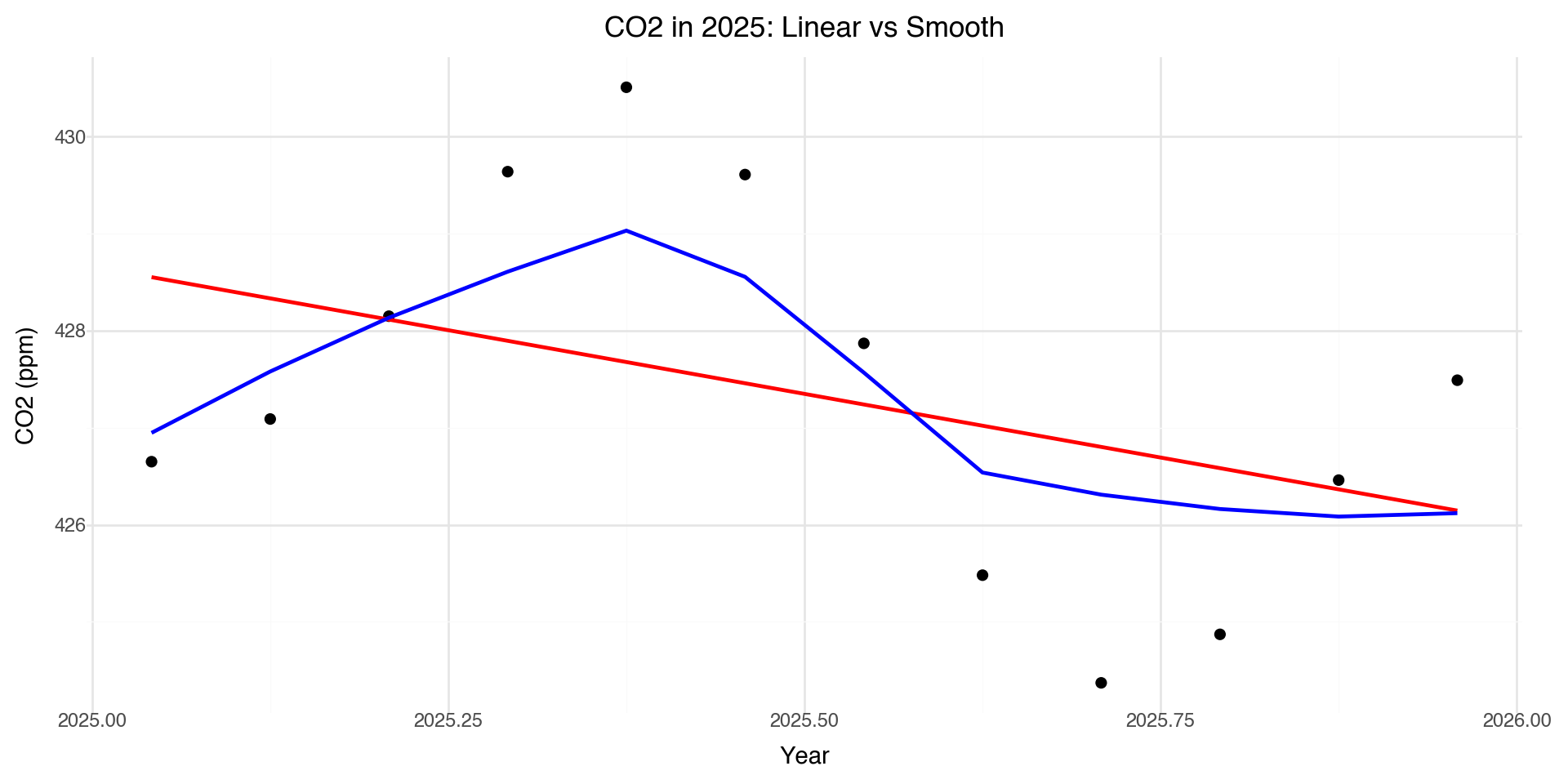
co2_2025 = co2[co2['year'] == 2025].copy()
(ggplot(co2_2025, aes(x='decimal date', y='co2')) +
  geom_point(size=2) +
  geom_smooth(method='lm', color='red', se=False) +
  geom_smooth(method='lowess', color='blue', se=False) +
  labs(x='Year', y='CO2 (ppm)',
       title='CO2 in 2025: Linear vs Smooth') +
  theme_minimal())

The smooth line captures the seasonal pattern that the linear model completely misses.

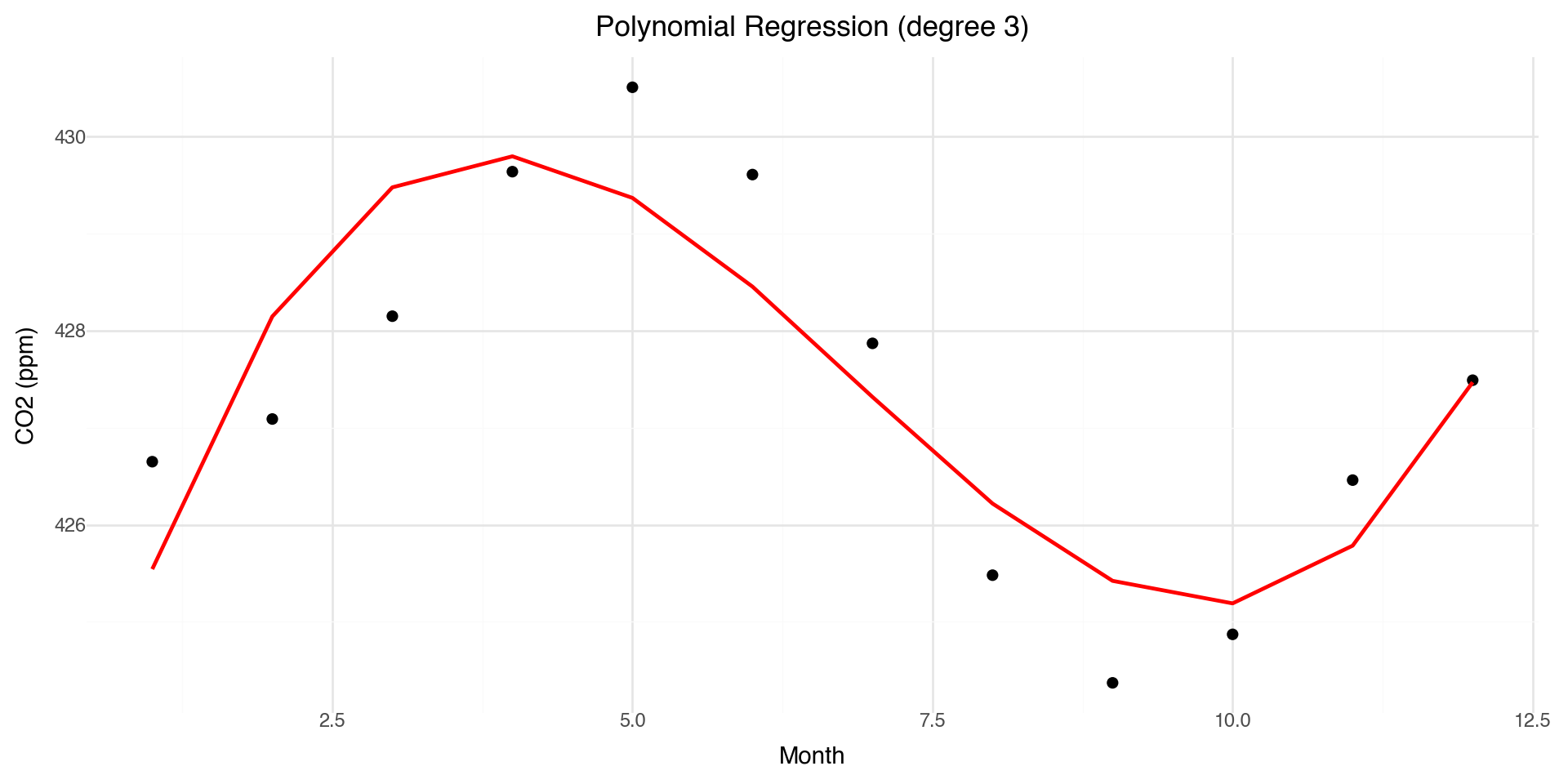
Polynomial Regression: A First Attempt

One approach to modeling non-linearity is polynomial regression:

\[y = \beta_0 + \beta_1 x + \beta_2 x^2 + \beta_3 x^3 + \ldots + \epsilon\]

from sklearn.preprocessing import PolynomialFeatures
from sklearn.linear_model import LinearRegression

# Fit polynomial regression (degree 3)
X = co2_2025[['month']].values
y = co2_2025['co2'].values

poly = PolynomialFeatures(degree=3)
X_poly = poly.fit_transform(X)
model = LinearRegression().fit(X_poly, y)

co2_2025['poly_pred'] = model.predict(X_poly)
print(f"Coefficients: {model.intercept_:.2f} + {model.coef_[1]:.2f}x + {model.coef_[2]:.2f}x² + {model.coef_[3]:.2f}x³")
Coefficients: 421.40 + 5.00x + -0.90x² + 0.04x³

Polynomial Fit Visualization

(ggplot(co2_2025, aes(x='month')) +
  geom_point(aes(y='co2'), size=2) +
  geom_line(aes(y='poly_pred'), color='red', size=1) +
  labs(x='Month', y='CO2 (ppm)',
       title='Polynomial Regression (degree 3)') +
  theme_minimal())

Problems with Polynomial Regression

  • Global behavior: Changing one coefficient affects the entire curve
  • Instability at boundaries: Polynomials can behave wildly at the edges (Runge’s phenomenon)
  • Poor extrapolation: Predictions outside the data range are unreliable
  • Choice of degree: How do we choose the right polynomial degree?

We need something more flexible and local. This motivates using splines.

Why Splines?

  • Polynomial regression: models non-linearity but has global effects
  • Splines: model structure in the mean function using piecewise polynomials

General setup:

\[y = f(x) + \epsilon, \quad \epsilon \sim N(0, \sigma^2 I)\]

  • Goal: estimate a smooth function \(f(x)\) that captures the trend
  • Benefits:
    • Flexible, nonparametric modeling of trends
    • Still yields prediction errors (statistical smoothing)
    • Naturally extended to generalized additive models (GAMs)

Basis Functions: Intuition

A basis is a set of simple functions \(\{b_j(x)\}\) that can be combined (with coefficients \(\beta_j\)) to approximate more complex functions \(f(x)\):

\[f(x) = \sum_{j=1}^k \beta_j b_j(x)\]

  • Example: polynomial basis \(b_1(x) = 1, \quad b_2(x) = x, \quad b_3(x) = x^2, \ldots\)

  • Analogy: like combining Lego blocks to build different shapes — basis functions are the blocks, coefficients \(\beta_j\) are how much of each block we use

  • The regression coefficients \(\beta_j\) control the contribution of each basis function

Basis Functions: Polynomial Example

Represent a complicated function \(f(x)\) as a linear combination of simpler basis functions:

\[f(x) = \sum_{j=1}^k \beta_j b_j(x)\]

Example: polynomial basis in 1-D:

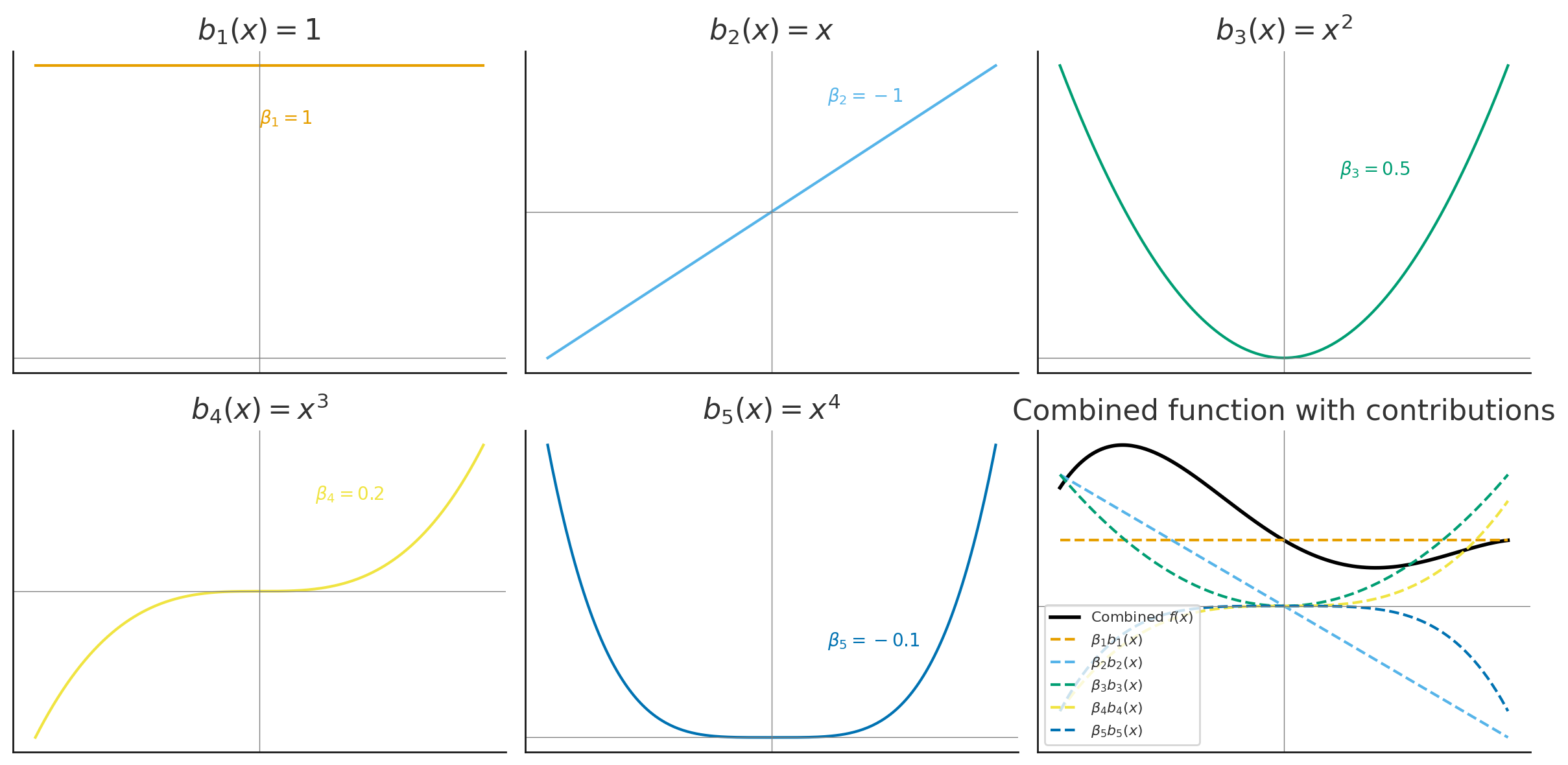
\[y_i = \beta_0 + \beta_1 x_i + \beta_2 x_i^2 + \beta_3 x_i^3 + \beta_4 x_i^4 + \epsilon_i\]

Basis functions:

\[b_1(x) = 1, \quad b_2(x) = x, \quad b_3(x) = x^2, \quad b_4(x) = x^3, \quad b_5(x) = x^4\]

Basis Functions: Matrix Form

Collect basis functions into a basis matrix \(\mathbf{B}\):

\[\mathbf{f} = \mathbf{B}\boldsymbol{\beta}\]

Example (polynomial basis):

\[\begin{bmatrix} f(x_1) \\ f(x_2) \\ \vdots \\ f(x_n) \end{bmatrix} = \begin{bmatrix} 1 & x_1 & x_1^2 & x_1^3 & x_1^4 \\ 1 & x_2 & x_2^2 & x_2^3 & x_2^4 \\ \vdots & \vdots & \vdots & \vdots & \vdots \\ 1 & x_n & x_n^2 & x_n^3 & x_n^4 \end{bmatrix} \begin{bmatrix} \beta_0 \\ \beta_1 \\ \beta_2 \\ \beta_3 \\ \beta_4 \end{bmatrix}\]

Polynomial Basis Visualization

The basis functions are each multiplied by \(\beta_j\) and then summed to give the final curve \(f(x)\).

Polynomial Basis: CO₂ Example

Monthly CO₂ data fit with a polynomial basis, each colored curve is a basis function scaled by its coefficient.

Polynomial Basis Recap

  • A function \(f(x)\) can be written as a weighted sum of polynomial basis functions:

\[f(x) = \sum_{j=0}^p \beta_j x^j\]

  • The coefficients \(\beta_j\) control the shape of the curve

  • Polynomials provide flexibility, but they can behave poorly:

    • High-order polynomials become unstable (“wiggly”)
    • Poor fit near boundaries (Runge’s phenomenon)
  • This motivates using splines: piecewise polynomials joined smoothly at knots

Splines: Concepts & Types

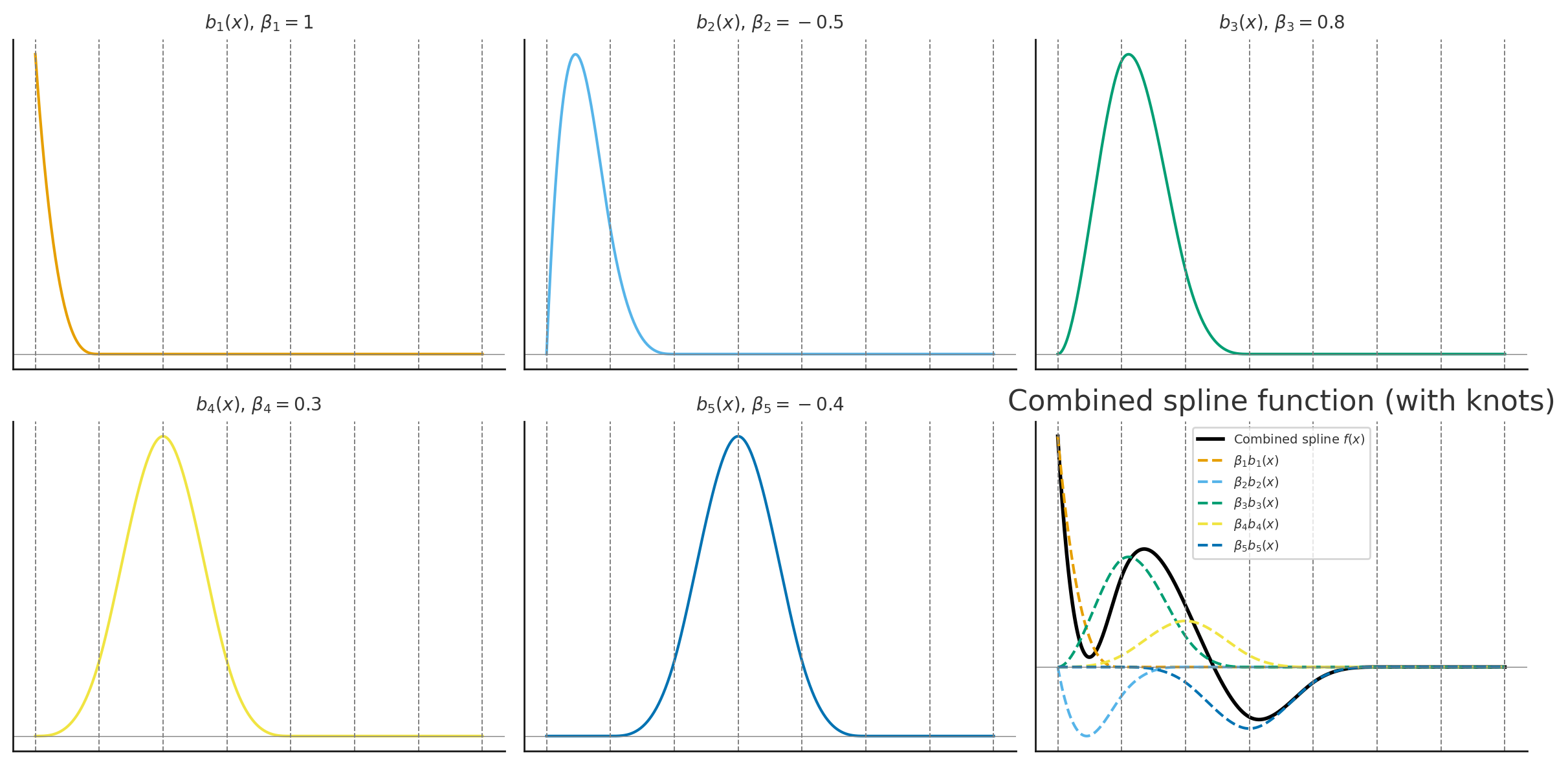
A spline is a function made up of piecewise polynomials:

  • Defined between knots (points where polynomial pieces join)
  • Joined smoothly (continuous first and second derivatives)

Advantages over high-order polynomials:

  • Flexible but stable (avoids oscillations at boundaries)
  • Local control: changing one knot only affects the nearby region

General form:

\[f(x) = \sum_{j=1}^K \beta_j b_j(x), \quad \text{where } b_j(x) \text{ are spline basis functions}\]

Types of Splines

  • Cubic splines: piecewise cubic polynomials joined smoothly
  • Natural splines: cubic splines with linear constraints at the boundaries (reduces edge wiggles)
  • B-splines: basis representation of splines using local polynomial pieces
  • Smoothing splines: knots at every observation, with a penalty \(\lambda\) to control wiggliness
  • Cyclic splines: cubic splines with connected ends (for periodic data like seasons)

Cubic Splines Example

Choosing the number and placement of knots controls smoothness:

  • Few knots \(\rightarrow\) smoother curve
  • Many knots \(\rightarrow\) wiggly curve

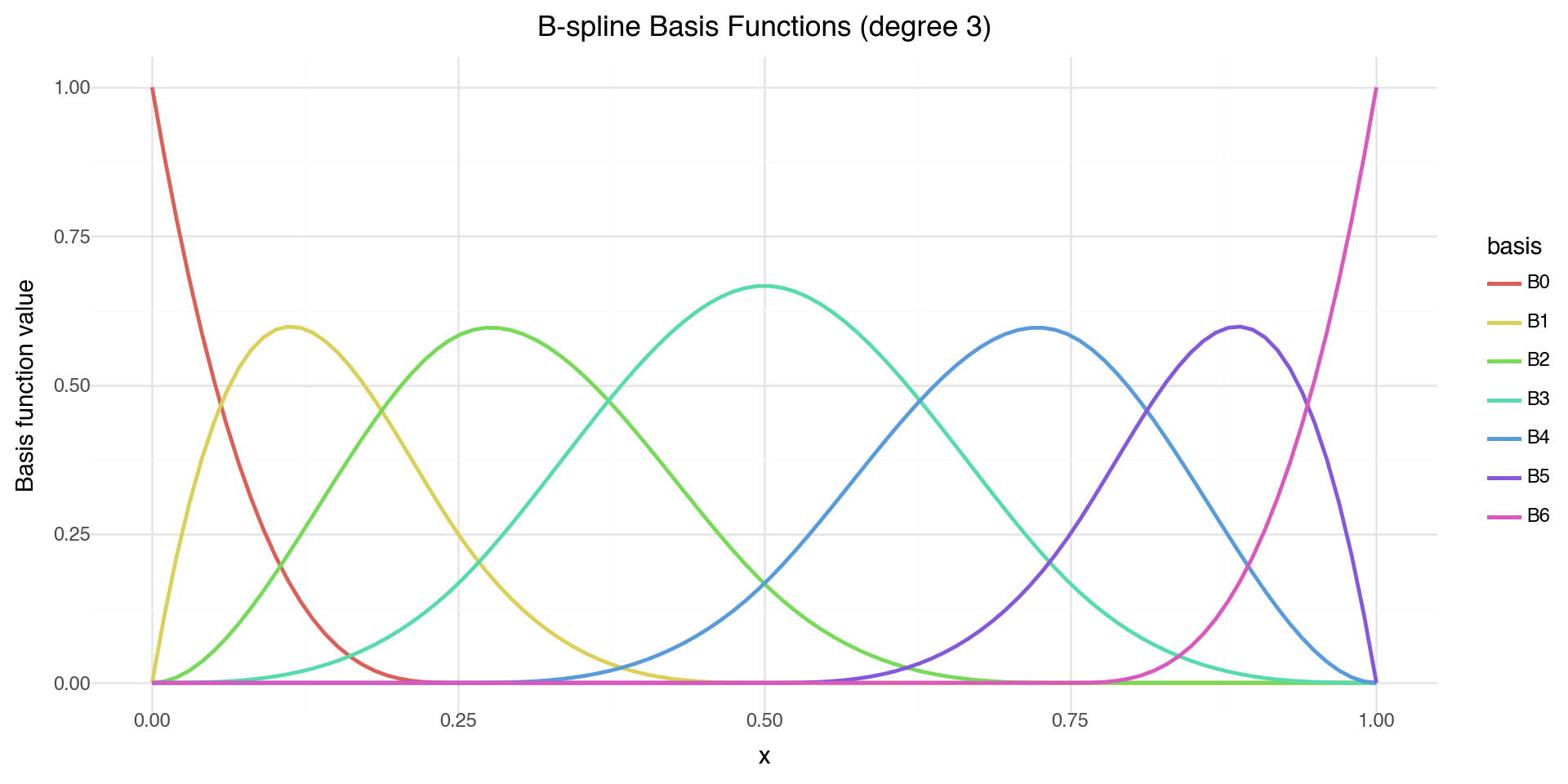
Visualizing B-spline Basis Functions

from scipy.interpolate import BSpline

# Create B-spline basis functions
x = np.linspace(0, 1, 100)
knots = [0, 0, 0, 0, 0.25, 0.5, 0.75, 1, 1, 1, 1]
degree = 3

basis_df = pd.DataFrame({'x': x})
for i in range(len(knots) - degree - 1):
    coeffs = np.zeros(len(knots) - degree - 1)
    coeffs[i] = 1
    spline = BSpline(knots, coeffs, degree)
    basis_df[f'B{i}'] = spline(x)

basis_long = basis_df.melt(id_vars='x', var_name='basis', value_name='y')

(ggplot(basis_long, aes(x='x', y='y', color='basis')) +
  geom_line(size=1) +
  labs(x='x', y='Basis function value',
       title='B-spline Basis Functions (degree 3)') +
  theme_minimal())

Each B-spline basis function is non-zero only over a limited range — this gives local control.

Smoothing Splines: Concept

Goal: Fit a smooth curve \(f(x)\) through noisy data \((x_i, y_i)\).

We want to balance:

  • Goodness of fit: match the data closely
  • Smoothness: avoid overly wiggly functions

Define an objective function:

\[\text{RSS}(f) + \lambda J(f)\]

where:

\[\text{RSS}(f) = \sum_i (y_i - f(x_i))^2, \quad J(f) = \int (f''(x))^2 \, dx\]

  • \(\lambda \geq 0\) is the smoothness parameter
    • Small \(\lambda\): fit the data very closely (wiggly curve)
    • Large \(\lambda\): force \(f\) to be smoother (nearly linear)

Smoothing Splines: Optimization

We minimize the penalized residual sum of squares:

\[\min_f \left\{ \sum_i (y_i - f(x_i))^2 + \lambda \int (f''(x))^2 \, dx \right\}\]

This is a trade-off between:

  • \(\sum_i (y_i - f(x_i))^2\) = data fidelity (how well the curve fits the observed points)
  • \(\int (f''(x))^2 \, dx\) = roughness penalty (penalizes curvature/wiggliness)

Solution: a natural cubic spline with knots at each unique \(x_i\).

The “best” curve is obtained by penalizing the wiggliness of the spline.

Smoothing Splines: Basis Representation

Represent \(f(x)\) using spline basis functions:

\[f(x) = \sum_{j=1}^K \beta_j b_j(x)\]

Let \(\mathbf{B}\) be the basis matrix and \(\mathbf{S}\) be the penalty matrix:

\[B_{ij} = b_j(x_i), \quad S_{jk} = \int b_j''(x) \, b_k''(x) \, dx\]

The optimization problem becomes:

\[\min_\beta \; (\mathbf{y} - \mathbf{B}\boldsymbol{\beta})^\top (\mathbf{y} - \mathbf{B}\boldsymbol{\beta}) + \lambda \boldsymbol{\beta}^\top \mathbf{S} \boldsymbol{\beta}\]

Solution (penalized least squares):

\[\hat{\boldsymbol{\beta}} = (\mathbf{B}^\top \mathbf{B} + \lambda \mathbf{S})^{-1} \mathbf{B}^\top \mathbf{y}\]

Smoothing Splines: CO₂ Example

A smoothing spline fit to the CO₂ data captures both the long-term trend and seasonal cycles.

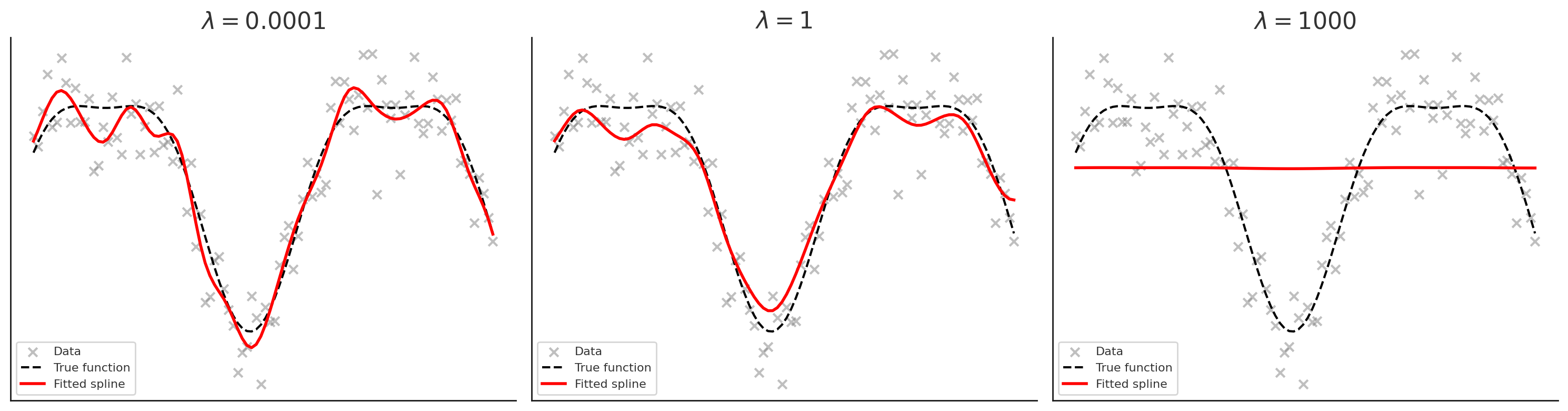
Effect of the Smoothing Parameter \(\lambda\)

  • Left (\(\lambda\) very small = 1e-4): spline is very wiggly, almost interpolates the noise
  • Middle (\(\lambda = 1\)): good balance between smoothness and fit
  • Right (\(\lambda\) very large = 1000): curve is almost straight (linear trend)

Knots vs. Penalty Parameter \(\lambda\)

In smoothing splines:

  • A knot is placed at each observation \(x_i\)
  • This gives the spline the potential to fit the data exactly

The penalty parameter \(\lambda\) controls how much we use that flexibility:

  • \(\lambda \to 0\): little penalty → spline interpolates the data (very wiggly)
  • \(\lambda \to \infty\): heavy penalty → spline approaches a straight line

Interpretation:

  • Knots: define the “vocabulary” of possible wiggles
  • \(\lambda\): decides how much of that vocabulary is actually used

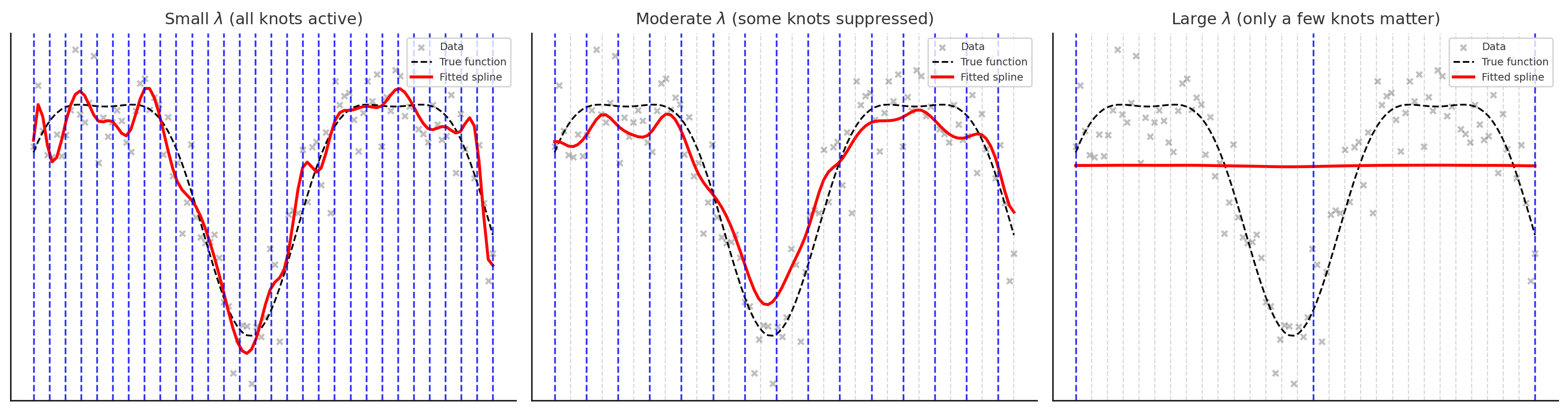
Knots vs. \(\lambda\): Visualization

  • Small \(\lambda\): all knots are active (blue), spline wiggles to fit data closely
  • Moderate \(\lambda\): only some knots are active, others are suppressed (grey), leading to a smoother curve
  • Large \(\lambda\): only a few key knots remain active, spline is very smooth

Types of 1-D Splines: Summary

Type Description
Cubic splines Piecewise cubic polynomials with smooth joins at knots
Natural cubic splines Cubic splines with boundary constraints (linear tails beyond boundary knots)
Periodic/Cyclic splines Enforce wrap-around continuity (function and derivatives match at endpoints)
B-splines A numerically stable basis representation for polynomial splines (local support)
Regression splines Finite set of knots; fit spline coefficients by least squares
Smoothing/penalized splines Knots at every point, add a roughness penalty \(\lambda\) to control fit-smoothness
Cardinal splines Knot placement is always a certain distance apart (common in grid settings)

From Splines to GAMs

A Generalized Additive Model (GAM) extends splines to multiple predictors. It is a regression model where predictors enter through a spline. GAMs can have a combination of splines and linear terms.

\[y = \beta_0 + s_1(x_1) + s_2(x_2) + \ldots + s_p(x_p) + \epsilon\]

Where each \(s_j(x_j)\) is a smooth function (typically a penalized cubic spline) of predictor \(x_j\).

Key advantages:

  • Each predictor can have its own non-linear relationship with the response
  • The effects are additive — total effect is the sum of individual smooth effects
  • Automatic smoothness selection — each \(s_j\) has its own penalty \(\lambda_j\)
  • Interpretable — you can plot each \(s_j(x_j)\) to see how predictor \(j\) affects \(y\)

GAMs in Python

In Python, we can fit GAMs using statsmodels or pygam.

Here we use pygam function LinearGAM

Read more here

# Prepare data
X = co2_2025[['decimal date']].values
y = co2_2025['co2'].values

# Fit GAM with smoothing spline (pygam)
gam = LinearGAM(s(0, n_splines=10)).fit(X, y)

GAM Summary

gam.summary()
  
print(gam.terms)
print(gam.coef_[:11])  # fitted coefficients
LinearGAM                                                                                                 
=============================================== ==========================================================
Distribution:                        NormalDist Effective DoF:                                      4.0838
Link Function:                     IdentityLink Log Likelihood:                                   -13.6117
Number of Samples:                           12 AIC:                                               37.3911
                                                AICc:                                               47.847
                                                GCV:                                                1.9142
                                                Scale:                                              0.8918
                                                Pseudo R-Squared:                                    0.847
==========================================================================================================
Feature Function                  Lambda               Rank         EDoF         P > x        Sig. Code   
================================= ==================== ============ ============ ============ ============
s(0)                              [0.6]                10           4.1          1.45e-02     *           
intercept                                              1            0.0          1.11e-16     ***         
==========================================================================================================
Significance codes:  0 '***' 0.001 '**' 0.01 '*' 0.05 '.' 0.1 ' ' 1

WARNING: Fitting splines and a linear function to a feature introduces a model identifiability problem
         which can cause p-values to appear significant when they are not.

WARNING: p-values calculated in this manner behave correctly for un-penalized models or models with
         known smoothing parameters, but when smoothing parameters have been estimated, the p-values
         are typically lower than they should be, meaning that the tests reject the null too readily.
s(0) + intercept
[ 36.58068341  38.26196477  39.94449927  41.23700237  40.90631244
  38.83656747  36.99855708  37.08258697  38.46904898  40.03810926
 388.35533059]

Interpreting GAM Summary

In pygam output:

  • s(k) represents a smooth function of predictor column k in your X matrix
  • f(k) represents a factor/categorical term (discrete levels)

Note on notation: In pygam, s() denotes smooth terms. This matches our mathematical notation \(s_j(x_j)\) for GAM smooth functions.

EDoF (effective degrees of freedom) tells you “what shape did the model learn?”

  • edf \(\approx\) 1: the term is essentially linear (heavily penalized)
  • edf 2–4: mild curvature
  • edf large: more wiggle/complexity (less penalized)

Lambda (\(\lambda\)) is the smoothing penalty — larger values = smoother curves

Interpreting GAM Coefficients

The output of gam.coef_[:] gives us the rank 10 spline basis weights (for s(0)): 36.58, 38.26, 39.94, 41.24, 40.91, 38.84, 37.00, 37.08, 38.47, 40.04

These are the beta weights \[s(x) = \sum_{j=1}^{10} \beta_j B_j(x)\]

And the intercept: 388.35533059

So the prediction is \(\hat{y} = \beta_0 + s(x)\) and the individual \(\beta_j\) values are usually not interpretable by themselves; the interpretable object is the curve \(s(x)\).

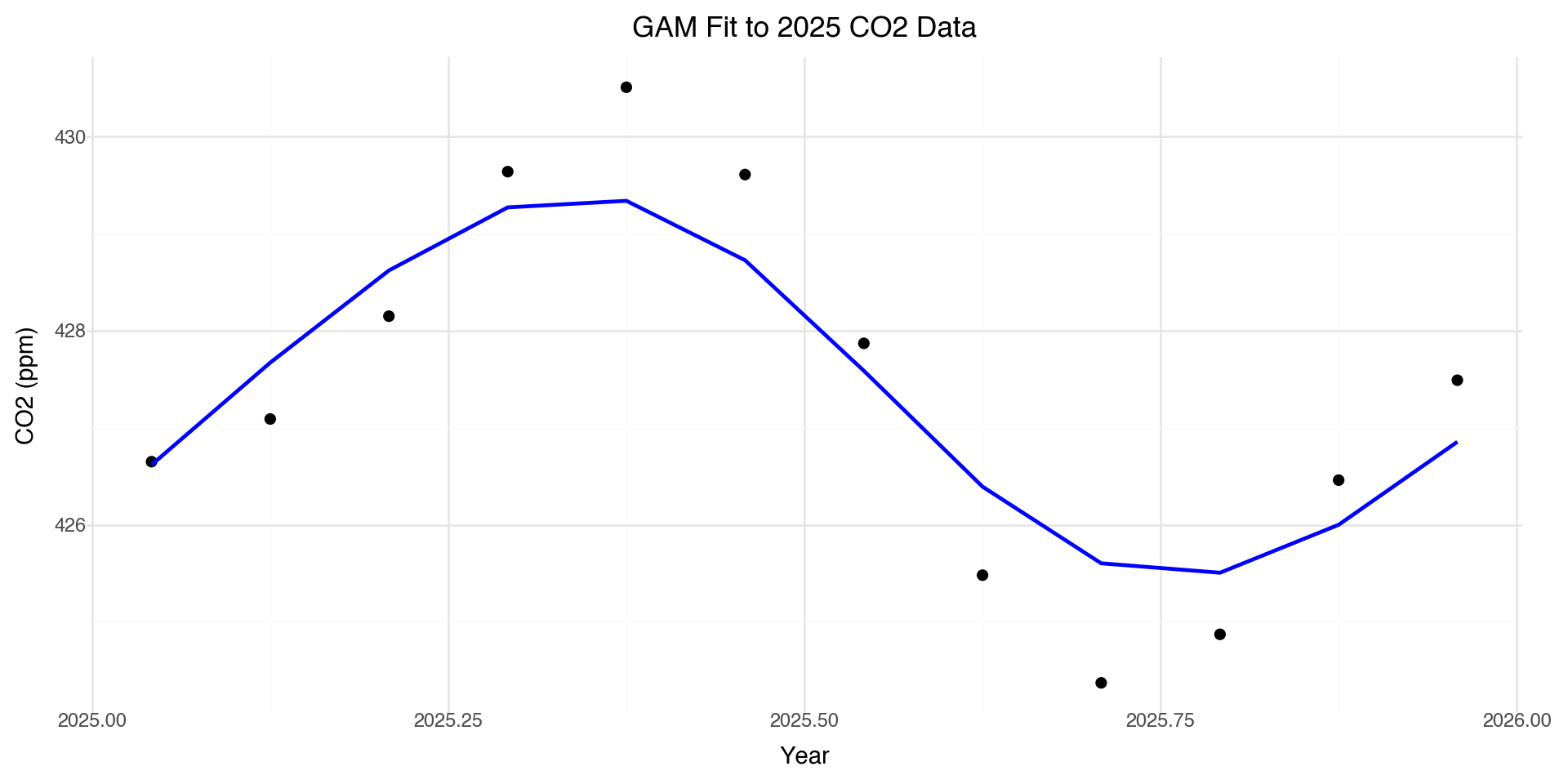
GAM Predictions

co2_2025['gam_pred'] = gam.predict(X)

(ggplot(co2_2025, aes(x='decimal date')) +
  geom_point(aes(y='co2'), size=2) +
  geom_line(aes(y='gam_pred'), color='blue', size=1) +
  labs(x='Year', y='CO2 (ppm)',
       title='GAM Fit to 2025 CO2 Data') +
  theme_minimal())

Fitting GAM to Full Dataset

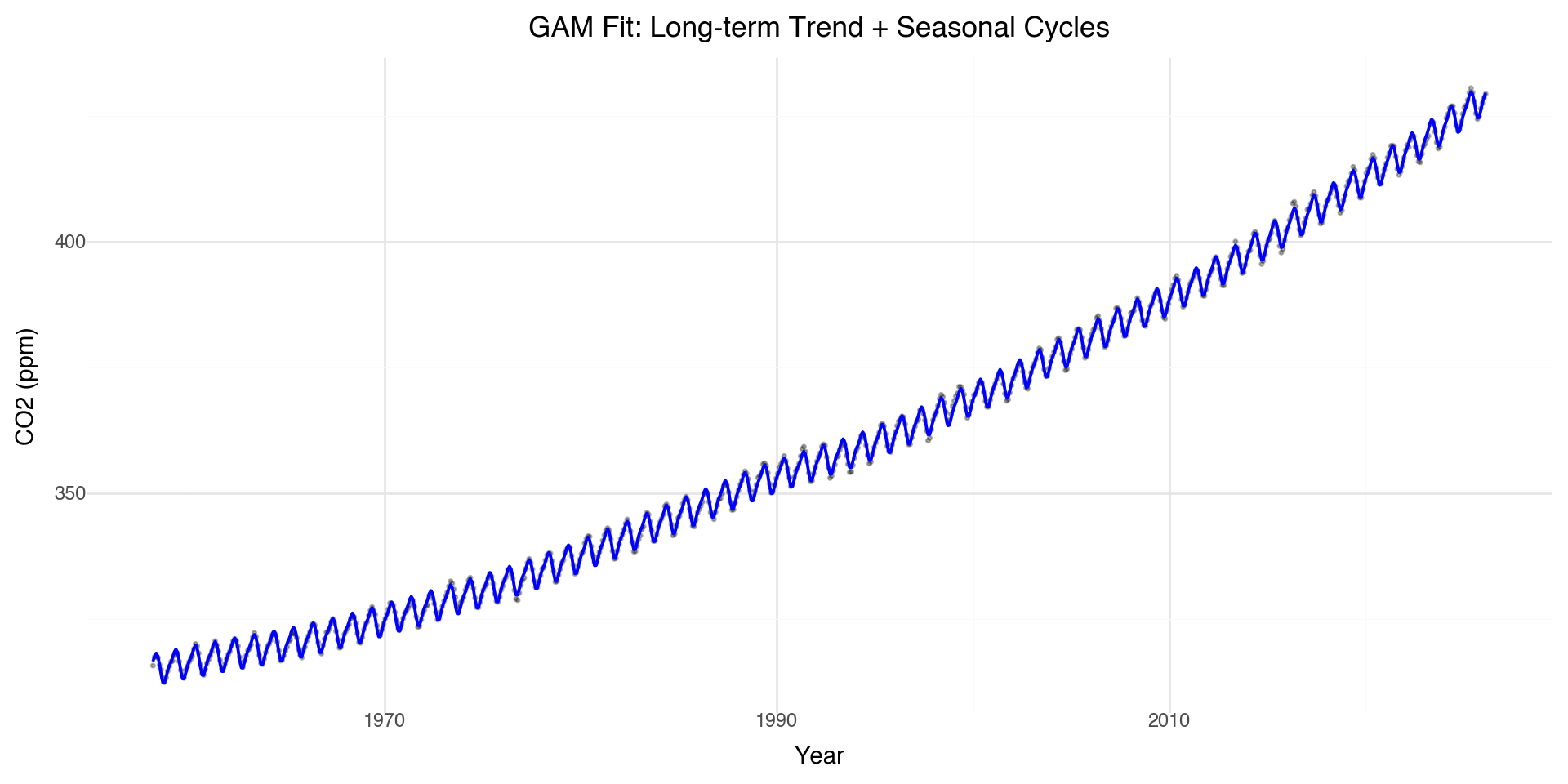
Let’s fit a GAM to capture both the long-term trend and seasonal cycles:

# Prepare full dataset
X_full = co2[['decimal date', 'month']].values
y_full = co2['co2'].values

# Fit GAM with two smooth terms
# s(0) for long-term trend, s(1) for seasonal (cyclic)

gam_full = LinearGAM(s(0, n_splines=20) + s(1, n_splines=12)).fit(X_full, y_full)
print(gam_full.summary())
LinearGAM                                                                                                 
=============================================== ==========================================================
Distribution:                        NormalDist Effective DoF:                                     21.5794
Link Function:                     IdentityLink Log Likelihood:                                   -503.623
Number of Samples:                          816 AIC:                                             1052.4048
                                                AICc:                                            1053.7486
                                                GCV:                                                0.2169
                                                Scale:                                              0.4545
                                                Pseudo R-Squared:                                   0.9998
==========================================================================================================
Feature Function                  Lambda               Rank         EDoF         P > x        Sig. Code   
================================= ==================== ============ ============ ============ ============
s(0)                              [0.6]                20           14.0         1.11e-16     ***         
s(1)                              [0.6]                12           7.6          1.11e-16     ***         
intercept                                              1            0.0          1.11e-16     ***         
==========================================================================================================
Significance codes:  0 '***' 0.001 '**' 0.01 '*' 0.05 '.' 0.1 ' ' 1

WARNING: Fitting splines and a linear function to a feature introduces a model identifiability problem
         which can cause p-values to appear significant when they are not.

WARNING: p-values calculated in this manner behave correctly for un-penalized models or models with
         known smoothing parameters, but when smoothing parameters have been estimated, the p-values
         are typically lower than they should be, meaning that the tests reject the null too readily.
None

Full GAM Visualization

co2['gam_pred'] = gam_full.predict(X_full)

(ggplot(co2, aes(x='decimal date')) +
  geom_point(aes(y='co2'), alpha=0.3, size=0.5) +
  geom_line(aes(y='gam_pred'), color='blue', size=0.8) +
  labs(x='Year', y='CO2 (ppm)',
       title='GAM Fit: Long-term Trend + Seasonal Cycles') +
  theme_minimal())

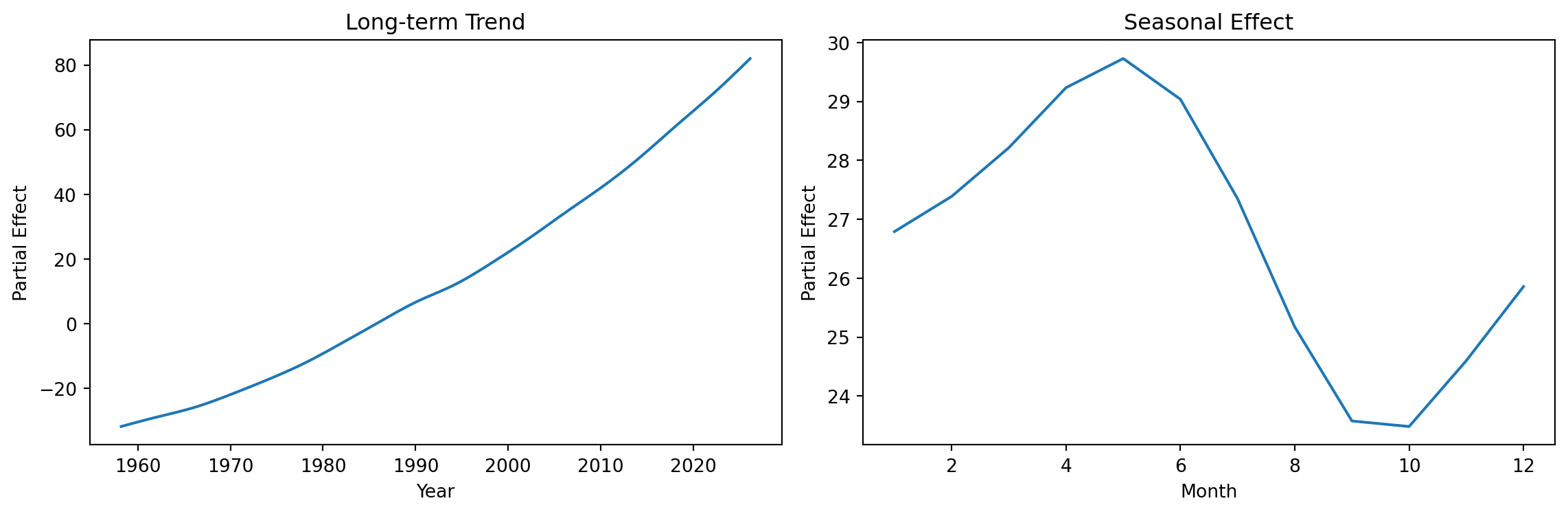
Partial Effects

GAMs allow us to visualize each smooth term separately:

fig, axes = plt.subplots(1, 2, figsize=(12, 4))

# Plot partial effect of decimal.date (long-term trend)
XX = gam_full.generate_X_grid(term=0, n=100)
axes[0].plot(XX[:, 0], gam_full.partial_dependence(term=0, X=XX))
axes[0].set_xlabel('Year')
axes[0].set_ylabel('Partial Effect')
axes[0].set_title('Long-term Trend')

# Plot partial effect of month (seasonal)
XX = gam_full.generate_X_grid(term=1, n=12)
axes[1].plot(XX[:, 1], gam_full.partial_dependence(term=1, X=XX))
axes[1].set_xlabel('Month')
axes[1].set_ylabel('Partial Effect')
axes[1].set_title('Seasonal Effect')

plt.tight_layout()
plt.show()

Connecting geom_smooth() to GAMs

When you use geom_smooth() in plotnine:

  • It’s using similar smoothing techniques under the hood
  • The method parameter controls the smoothing approach:
    • 'lm': Linear regression
    • 'lowess': Local regression (default for small data)
    • 'gam': Generalized Additive Model (R’s ggplot2)
  • The smooth adapts to your data automatically
# These are conceptually similar:
geom_smooth()  # Automatic smoothing
geom_smooth(method='lowess')  # Local regression
# In R: geom_smooth(method='gam')  # GAM smoothing

Key GAM Concepts

Concept Description
Spline Piecewise polynomial with smooth connections
Knots Points where polynomial pieces connect
Basis functions \(b_j(x)\) Building blocks combined to form the smooth
Penalization (\(\lambda\)) Controls wiggliness, prevents overfitting
EDF Effective degrees of freedom (complexity measure)

Notation convention:

  • \(f(x) = \sum_j \beta_j b_j(x)\): a spline (smooth function built from basis functions)
  • \(s_j(x_j)\): smooth term for predictor \(x_j\) in a GAM

When to Use GAMs

GAMs are useful when:

  • You expect non-linear relationships but don’t know the exact form
  • You want interpretable models (can visualize each smooth)
  • You have enough data to estimate smooth functions reliably
  • You want to capture seasonal patterns or trends

Cautions:

  • GAMs can overfit with too many knots
  • Higher EDF = more complex model = potential overfitting

  • Always validate on held-out data!

Summary: Smooth Regression

  1. Linear models assume straight-line relationships: \(y = \beta_0 + \beta_1 x\)
  2. Polynomial regression allows curves but has global effects and boundary issues
  3. Splines \(f(x) = \sum_j \beta_j b_j(x)\) are piecewise polynomials joined at knots
  4. Smoothing parameter \(\lambda\) controls the bias-variance tradeoff
  5. GAMs model each predictor flexibly: \(y = \beta_0 + s_1(x_1) + \ldots + s_p(x_p)\)
  6. geom_smooth() uses these techniques under the hood
  7. In Python: use pygam or statsmodels for GAM fitting (pygam shown today)
Python Libraries for GAMs

Library Description
pygam Pure Python GAM implementation, easy to use
statsmodels GLMGam class for GAMs
scikit-learn Spline transformers for feature engineering
scipy Low-level spline interpolation

References

  • Wood, S.N. (2017). Generalized Additive Models: An Introduction with R
  • Hastie, T. & Tibshirani, R. (1990). Generalized Additive Models
  • pygam documentation: https://pygam.readthedocs.io/
  • plotnine documentation: https://plotnine.readthedocs.io/